Wednesday, May 1, 2024

Early Merchants in Downtown Kingstree

While it is likely that Williamsburgh at the King's Tree was the first inland settlement in South Carolina, the town that would later become known as Kingstree did not develop quickly. As an incentive to settle here, early settlers were given acreage according to the number of persons in their families and a one-half acre town lot. Instead of building their homes in town, most of them opted for building on their acreage. According to W.W. Boddie in his History of Williamsburg, the town of Williamsburgh until 1788 was little more than a cleared space used as a parade and muster grounds. Today, the Williamsburg County Courthouse stands on the old muster ground. 


The historical marker in front of the Williamsburg County Courthouse, noting
that the lot on which the courthouse sits once served as the muster ground.

Boddie continues, "There were in the town in 1788 five small buildings, not one of them more than 20 x 20 feet. Two of them were located where the Wee Nee Bank now stands (Northeast corner of Main and Academy streets). In one of them William Bracey lived; in the other he kept a mercantile establishment. His stock of merchandise usually consisted of one barrel of whiskey, one bag of buckshot, one bag of squirrel shot, one bag of turkey shot, one keg of powder, a few tallow candles, and a few sealing wax wafers. Occasionally, when an especially prosperous season indicated a good trade, he would add five pounds of linen writing paper to his stock of goods. Powder and shot and whiskey were the only salable items all year round. 


William Bracey lived and operated a business from two small buildings on this lot
in 1788. By the 1870s, Samuel Flint had built a large house on the lot, and Louis
Stackley constructed the current building for his general merchandise store in the early 1900s. It was
remodeled for the Wee Nee Bank after Stackley assumed the role of postmaster. It 
also briefly housed the post office before it moved into its new building on Mill Street.

"One the other side of Broad Street (now Main Street) were three little houses. Patrick Cormick lived in one of these. It was located where the Hammet residence now stands (now the location of the Williamsburg County Administrative Building). He had a little store near his home, which store was similar to that of William Bracey across the street. John Brady lived in a little house where the Court House now is."

Boddie doesn't provide us with documentation of where he got his information, but, given the specificity with which he writes, he must have had access to someone's reminiscences or some other documents as source material. 

From old newspapers we know that in the early 1800s there were at least two merchants active in Kingstree. One of them was Asa Thomas, whose name was regularly attached to ads in Charleston newspapers during 1811-12, indicating that he was selling a patent medicine, Dr. Roger's Vegetable Pulmonic Detergent, at the King's Tree for use against asthma and other diseases of the lungs. He appears to have died in 1813, as court records show that his wife as Administratrix and the Administrators of his estate were involved in numerous law suits in March, 1814, in what appears to be attempts to collect monies owed him. There were suits against Thomas & George McConnell; Eliphalet Hewitt & George McConnell; J.B. Cummings; William H. Mouzon, John Blakely; William P. & Robert C. McConnell; John Blakely & John McNeely.

In October, 1814, in a suit against William P. McConnell and S. & G. McConnell, the plaintiffs' attorney, Mayrant, moved, and the judge ordered that the sheriff must show cause why he had not levied and paid over the monies of this case. The sheriff either refused or neglected to show sufficient cause, or even to answer, so that Mayrant then moved that the sheriff be held in contempt. 

Another merchant in Kingstree in these early years was young Isaac A. Cohen. Cohen was born in Charleston around 1797. All we know of him is a death notice in the October 16, 1819, issue of the New York Evening Post, which read, "Died at Kingstree (S.C.) age 22, Mr. Isaac A. Cohen, merchant of that place. 


Death notice for Isaac A. Cohen in the New York Evening Post.

According to the JewishGen Online Worldwide Burial Registry, Cohen died on September 29, 1819, in Williamsburg County, aged 21 years, 9 months. He is buried at Kahal Kadosh Beth Elohim Cemetery on Coming Street in Charleston, although his grave marker has been lost. Find-a-Grave has a newspaper In Memorium posted, although the name of the newspaper is not listed: It reads: We are called to pay a melancholy tribute to the memory of Mr. Isaac A. Cohen, a merchant of Kingstree, who died at that place in the 22d year of his age. Gentle and courteous in manners of principles the most manly and virtuous, Mr. Cohen had endeared himself to all who had the pleasure of his acquaintance. But all the merit of integrity, all the loveliness of youth, and all the beauty of virtue are alike subject to the relentless shafts of death; they pass from our sight and leave but a memory of what they were. This is the solace of his surviving friends, that the spirit of the deceased is happy in heaven as it was pure and unblemished on earth.

While we don't know where either Thomas or Cohen's businesses were located in Kingstree, it seems quite likely that Cohen was Kingstree's first Jewish merchant. 

Kingstree remained a sleepy village for several decades. The best reference for businesses in Kingstree in the mid-1800s comes from Dr. Samuel D. McGill's Reminiscences.

In one story, he remembers that someone living on Black River once caught a large alligator. The man dragged it to Kingstree and secured it in the back room of the McElveen and McWilliams tailor shop. From there he exhibited the alligator, throwing in a free drink for every viewing. Dr. McGill notes that the attraction drew large crowds, concluding, "Those who lingered until they were made to see double were remarked upon as being full of the alligator soup." He does not, however, pinpoint where this tailor shop was located in downtown Kingstree. 

One of the early enterprises remembered by Dr. McGill was that of Carter Thomas Baughan, who moved to Kingstree from Fayetteville, NC, to go into business with his brother-in-law, Dr. Richard Jarrott. They opened the business in the old courthouse, likely where Hardee's is today, where they carried a full range of general merchandise. The Baughan family lived on the second floor of the building. John M. Jarrott ran a workshop building gins and their fixtures in the old county jail. Dr. McGill doesn't pinpoint where this jail was located. 

Robert J. Patterson, assisted by Robert Flinn, produced riding chairs and sulkies in another downtown location, according to Dr. McGill. 

In the 1840s and '50s, two of the busiest downtown establishments were the Nelson House and the Staggers Hotel. The Nelson House was located at the southeastern corner of Main and Academy, while the Staggers Hotel was on the northeastern corner of what is now Main and Jackson streets. James Martin Staggers also ran a general store and his son Dr. James Marion Staggers ran a drugstore. Martin Staggers was very much involved in the civic life of the community, serving as mayor. In his unpublished reminiscences, the late Sen. E.C. Epps stated that the Staggers store, a brick building, was old when Epps was a boy in the late 1870s and early 1880s. 

Dr. McGill reminisced that during election years the two hotels were the sites of political meetings with the Republicans meeting in one of the hotels, while the Democrats met at the other. 


The Nelson House remained a landmark in Kingstree until it was torn down in the late 1950s.

Two other stores were built before the Civil War, one constructed to rent by Col. J.J. Tisdale and another by S.J. and T. Jeff Strong, brothers, who carried a large stock of goods. 

Englishman Daniel H. Jones operated a tailor shop across the street from the Williamsburg County Courthouse. He, too, lived above his shop. He daughter, Charlotte, would become postmistress for Kingstree in the late 1880s. Much more about her at a later time. 

Another store located across the street from the Courthouse was built by Joseph R. Fulmore and Peter Mouzon. They sold this store to Samuel P. Matthews, while Fulmore & Mouzon constructed another large store, this one likely located on the corner of Longstreet and Main streets where McDonald's is today. or perhaps one lot in on Main Street from that corner.  

In 1856, Joseph E. McKnight, according to Dr. McGill, "introduced the printing press to Kingstree and edited the Kingstree Star. His office was situated below Staggers' Hotel, on the Main Street leading down to Kingstree bridge across Black River." This building was located between the small store owned by Mary Jane Porter and run by her son, James, and the large store of Fulmore & Mouzon. 


Wednesday, April 10, 2024

The Gewinner/Jacobs Women Made Their Mark


Barbara and John Konrad Gewinner came to this country from Bavaria, settling in Kingstree in 1854. Konrad was a shoemaker, and it appears that by 1860, the Gewinners were running a boarding house/hotel in their home located on the southeastern corner of  W. Main and Longstreet streets, where Hardee's sits today. The 1860 census shows that in addition to the Gewinner family, 18-year-old William Stampfer, also a shoemaker, was living with them, as were 24-year-old merchant Louis Greenfield, and printer Walter Logan, age 29.


Somewhere in this area of Main Street Barbara Gewinner ran a shop during the late 1870s.

 Records from the United States Freedmen's Bureau show that it paid John K. Gewinner $12 on September 1, 1866, for allocating two rooms in his home as a Teacher's Home. Konrad died in August, 1869. The 1870 census lists Barbara as a hotel keeper. Also listed in the Gewinner household in 1870 was Col. Garrett Nagle, 33, the Williamsburg County Agent for the Freedmen's Bureau at that time. According to Edwin Christopher Epps' unpublished reminiscences of growing up in Kingstree, Mrs. Gewinner also ran a small shop located on Main Street across from the courthouse during the late 1870s and 1880s. He does not specify what she sold in her shop, but she was one of the few women business owners of that period.


Mary Gewinner Jacobs
Kingstree's first female postmaster

 The Gewinners' daughter, Mary Frederika, was appointed postmistress for Kingstree in 1866, when she was only 18 years old. The Charleston Daily News of July 27, 1866, noted, "The Kingstree Star of the 25th boasts of that village now having a regular "reconstructed" post office, Miss Mary Gewinner having received the appointment of Postmistress. The Star says that Miss G has been attending the mails for some months past. Miss G, it would then appear, has been more successful in her attendance on the mails than many of her sisters." 

Mary Gewinner married Louis Jacobs in 1870 and over the next 10 years, the couple produced eight children. In 1880, they moved to Charleston, primarily because Mr. Jacobs felt it was cheaper to move his family there than it was to arrange lodging for his children to attend school in Charleston. Barbara Gewinner died in 1893, and when the Jacobs family returned to Kingstree, Louis Jacobs built a Charleston-style home on the old Gewinner lot at the corner of Main and Longstreet. The interesting feature of the home was that its back faced Longstreet, with the front of the house facing the interior of the lot. 

In the late 1890s, one or more of the Jacobs' daughters went into the millinery business with one or more of the Benjamin sisters. Benjamin & Jacobs Millinery operated out of a store Louis Jacobs owned on the west side of Academy Street, where the Downtown CafĂ© is today. 


The Misses Benjamin & Jacobs operated a millinery store on this site in the late 1890s.

On April 1, 1898, Louis Jacobs, following in his wife's footsteps, was appointed postmaster for Kingstree. He immediately moved the post office from the east side of Academy to the building on the west side that had housed Benjamin & Jacobs Millinery. The County Record, in announcing the move, also noted that Louis Jacobs' daughter, Etta, would serve as Assistant Postmaster. 

Etta Jacobs, however, was already certified as a teacher and had taught in the Sampit section of Georgetown County in 1897. She later taught at Smith's Mills in northern Williamsburg County, Gourdin, and Heinemann, and in 1907 was named the principal of Salters High School. She later taught near Spartanburg, before returning to Williamsburg County as an assistant teacher in the school at Cedar Swamp. During her years in education, she was extremely active in Williamsburg County Teachers' Association, where she served on the executive committee for a number of years. She was also a member of the School Improvement Association of South Carolina. She was also a sponsor of Camp James McCutchen, an organization of Civil War veterans.


After her father's death in 1913, she left teaching to run his insurance agency, re-naming it the Etta Jacobs Agency. The Town of Kingstree treasurer's report shows that from 1914 through at least 1917, the town was paying insurance premiums to her agency. Ad ad in the November 29, 1917, issue of The County Record, signed by the Etta Jacobs Agency and Kingstree Insurance, Real Estate, and Loan, warned businesses carrying fireworks that they must first secure a permit from their insurance company to do so. If they did not get this permit, their policies would be canceled immediately. 

While Etta pursued a career in education, her older sister, Mary, known as Mamie, took over as assistant postmaster. She served in this capacity for 15 years until her marriage to Theodore B. Gourdin, the great-uncle of Governor Henry McMaster, and a subsequent move to Salters. Mamie was also a loyal member of the Kingstree Civic League, serving as its secretary. 

The youngest of the Jacobs' daughters, Florence, known as Florrie, made her mark as a legal stenographer. She began her career at the Kingstree firm of Lee & Shuler, but spent the last 10 years of her life employed by attorney Samuel Want in Darlington. She was rated as one of the most expert stenographers in the state of South Carolina. 


In 1929, Cecil and Edith Jacobs owned a home on this property from which
Edith and Freda Jacobs ran The Cottage Tea Room.

Two of Louis and Mary Jacobs' daughters-in-law also exhibited an entrepreneurial spirit. In the spring of 1929, Freda and Edith Jacobs, wives of W. N. "Nappie" and Cecil Jacobs opened the Cottage Tea Room at the home of Edith and Cecil Jacobs. This house was located across Longstreet from the Jacobs' family home. The announcement of the tea room's opening in the April 11, 1929, issue of The State, noted that "this is an ideal location as the Atlantic Coastal highway with its daily rush of tourists passes directly in front of Mrs. Jacobs' home. The tea room, which remained in business for several years, was also the site of many local luncheons, showers, bridge club meetings and birthday parties. In December, 1930, Edith and Cecil Jacobs hosted a Christmas dinner at the tea room for the managers and assistants of Kingstree's filling stations. 

Wednesday, March 20, 2024

Clara Gagg Harper Wilkins Was Early Kingstree Business Owner

Today, Kingstree can boast that many of its downtown businesses are women-owned. Women have been active in the business community here for a long, long time. One of those early women business owners was Clara Jane Gagg Harper Wilkins. 


This building now stands on the location where Clara J. Harper, her brother
and brother-in-law opened a general merchandise store in 1900.

C.G. Harper came to Kingstree in 1900 from Trenton, NJ, accompanying her brother Aaron W. Gagg and their brother-in-law, William B. Oliver, who was then the general manager of the Union Paper Company in New Hope, PA. 

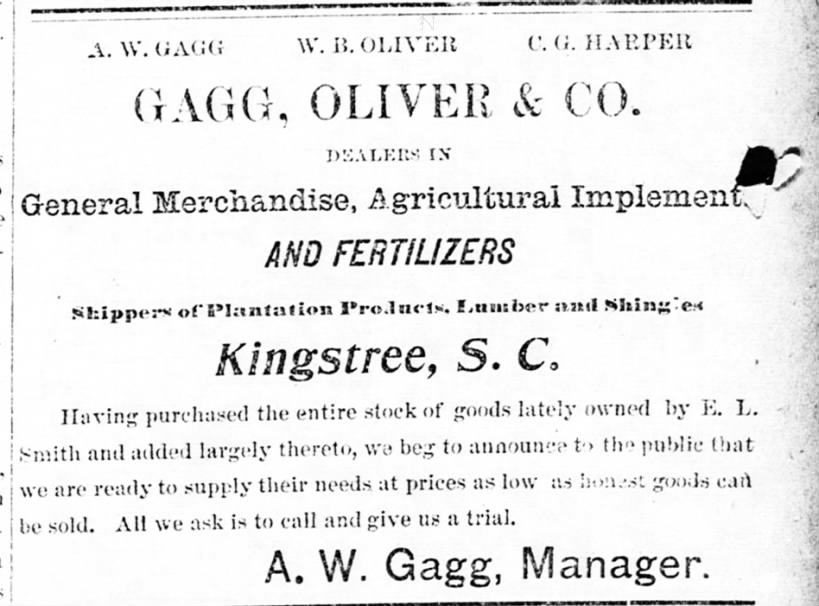
It's not clear what attracted this trio to Kingstree, but they were impressed enough after a visit to decide to partner in a retail establishment. In January, 1900, an opportunity presented itself when E. L. Smith, who was operating a store on the east side of Academy Street in a wooden building on the lot where the brick building that today hosts the "We Believe in Kingstree" mural now stands, found himself with greater liabilities than assets and assigned what he owned to R.K. Wallace, who sold all of Smith's merchandise at auction on February 12. A.W. Gagg, seeing his opportunity, bought the merchandise with a $3200 bid, and re-opened the store in the same location under the name Gagg, Oliver & Co.


One of Gagg, Oliver & Co.'s early ads in The County Record. 
Note that Gagg, Oliver and Harper all all named in the ad.

Gagg immediately announced that he had also bought the vacant lot on the southwest corner of Mill and Academy streets where M.F. Heller's old livery stable had recently been torn down and planned to build a modern, brick store for Gagg, Oliver & Co. This property is now occupied by Styles & Smiles Hair Salon.

By October, 1900, the new store was almost completed. The County Record noted that with its "large, plate-glass windows and handsomely furnished interior, this building makes quite a brave show in that part of town."


Styles & Smiles currently occupies the location of Gagg, Oliver & Co.'s new building.

By February, 1901, W.B. Oliver, who seems to have been more of a silent partner, sold his interest in the business to A.W. Gagg, as Oliver was moving to Virginia to pursue yet another business endeavor. Clara Harper, however, remained a partner in the business. She was also apparently well-liked in Kingstree and was invited to and attended numerous local dances and parties.


Gagg, Oliver's ad for its new brick store from the November 8, 1900, County Record.

For Easter, 1901, Gagg, Oliver & Co. created a bit of a stir downtown with an Easter display in its show window, a first for a business in downtown Kingstree. According to the newspaper, this display "pleases the young folks immensely."

The store also made news that August. When Aaron Gagg's son, Russell, entered the store on Monday, August 5, he was shocked to find merchandise scattered all over the floor. Looking further, he saw that the glass in the back door had been shattered. While he was unsure of all the items stolen during the burglary, he was able to say that six revolvers, 20 boxes of cartridges, four pairs of shoes, two satchels, three or four suits of clothes, several hats and pairs of suspenders, and a number of pocket knives were missing.

Farmers had very bad years in 1900 and 1901 which affected the bottom line of a number of local merchants, causing a rash of bankruptcies. Gagg, Oliver & Co., held on longer than some of the others, but by January, 1902, it issued a deed of assignment to local attorney Robert J. Kirk for the benefit of the business' creditors. Happily, by early April, Gagg, Oliver had paid off its creditors and was able to re-open the store. 

But the magic appears to have worn off for Aaron Gagg, and in September, 1902, he announced that the store was going out of business. Two months, later, however, he announced that he was selling his interest to his sister, Clara Jane Harper, who would keep the business open. However, she planned to move from the brick store back across the street to the spot where Gagg, Harper had originally opened. 

In early December, William Thomas Wilkins rented the store which Clara Harper had vacated, so that he now had two stores directly across the street from each other.

We will look at W.T. Wilkins and his influence on downtown Kingstree in a later post. His wife, the former Cora Hudgins of Foreston in Clarendon County, died in 1904, leaving him with four young children–Will, Joe, Archie and Rosa. In 1906, he married Clara Harper.

In 1909, Clara's daughter, Adelaide Harper, married her stepfather's brother, Samuel Wilkins, and moved with him to Georgia. Older residents of Kingstree, however, will probably remember that Adelaide and her daughter, Adelaide Wilkins Willis, returned to Kingstree years later and lived on the old Wilkins property, now the vacant lot on Academy Street between First Baptist Church and the Williamsburg County School District Office. 

Clara Jane Gagg Harper Wilkins died at the home of her daughter in Georgia in May, 1936. She is buried in Williamsburg Cemetery. 


Wednesday, March 6, 2024

Thomas Opera House Site of a Kingstree Mystery

March 19 will mark the 116th anniversary of the Grand Opening of the Thomas Opera House, located on the corner of Main and Jail (now Jackson) streets in Kingstree in what is now known as the Alex Chatman Complex. The opera house, located on the second floor of the building, was a "gift" to the town from its builder, Fulton Courtney Thomas, who was born in Williamsburg County in 1859, but who moved to Manning as a young adult to open a mercantile business.


The upper story of this portion of the Alex Chatman Complex was used as the opera house.

When that business failed, F.C. Thomas headed west, landing in Fayette, Texas, where he went into the livestock business and married a woman named Bloom Smith. Several years later, Thomas decided to move back to Manning, where he went into partnership with D.M. Bradham, opening a livery stable, known as Thomas & Bradham. The two were so successful that several years later they opened a branch of the livery stable in Kingstree, located on Jail Street in the vicinity of today's County Auditorium. 

At that time, there were two wooden stores on Main Street in front of the livery stable. They were owned by George Barr and used in connection with Barr's Hotel. In 1905, W.T. Wilkins bought these two stores, one from George Barr's widow Lula and the other from Isaac A. Keels, who had taken over the hotel at Barr's death. Wilkins rented the two stores to two African-American-owned businesses, Wilson McCullough & Co., and another business whose name is currently not known. 

On December 31, 1906, an early morning fire swept through the entire block of stores from the Courthouse to Jail Street, burning the old Barr hotel, then called the Central Hotel; Dr. W.L. Wallace's drugstore, and the two buildings owned by W.T. Wilkins. In February, 1907, Wilkins sold the lots on which his two stores had been located to F.C. Thomas. 

In May of that year, Thomas broke ground for what was to be a two-story brick building that would house two stores on the first floor and an opera house/community hall on the second. V.A. Sedgewick of Mayfield, KY,  was the contractor. The building was completed by October, 1907. The County Record noted that the second floor was well-suited for use as an opera house, as it was equipped with a wide stage, dressing rooms, and a rear entrance. 

The first event to take place in the opera house, in January, 1908, was not an opera. It was, in fact, a wrestling match between Luis Winnick of Tennessee and Bob Cain, known as the "South Carolina Wonder." 

The next month, J.R. McNair, who was associated with The New York Clipper, a weekly entertainment newspaper in New York City, was in town to paint the drop curtain and scenery for the opera house. The central part of the curtain depicted Commodore Dewey at Manila from the Battle of Manila Bay during the Spanish-American War of 1898 with the borders and panel decorations exquisitely colored in vivid tints. 

On Thursday evening, March 19, ticket-holders from near and far flocked to Main Street for the Grand Opening of the Opera House. The Beggar Prince Opera Company of New York presented the Turkish Opera, Said Pasha, a romantic opera in three acts, to a full house of approximately 300 patrons, some of whom had traveled to Kingstree from Greeleyville, Salters, Cades, and Indiantown. 


The name "Thomas" can still be see on granite plaque on the front of the building.

Over the next few years, several men, including Philip Stoll and Louis Stackley, managed the opera house. They booked numerous traveling companies who would come to Kingstree for a three-night engagement, putting on a different play each evening. The regular season for the opera house ran from October until March. During the late spring and summer, the opera house was used for local events, including fundraisers for the local school and churches, Confederate Memorial Day exercises, and conventions for the Knights of Pythias and other fraternal organizations. In November, 1908, election returns were posted at the opera house. On several occasions, local talent put on plays to raise money for various organizations. 

Tragedy struck in November, 1910, in the form of a shooting, aspects of which still remain a mystery. On Friday evening, November 4,  a magician was scheduled to perform at the opera house. As patrons were beginning to find their seats for the performance, the sound of a shot rang out from the front of the opera house, and William "Pinky" Scott, a 10-year-old African-American boy who was seated near the front of the hall, toppled out of his seat, shot through the head. The shot came from a Colt automatic pistol, a prop for the evening's performance, which was in the possession of 17-year-old William J. Britton, who was to assist the magician in his act. Scott was rushed across the street to Gamble & Jacobs' drugstore where Dr. C.D Jacobs attempted to save his life, but the .25-calibre bullet had struck him squarely in the forehead, and he was pronounced dead about 30 minutes after the shooting. 

At the Coroner's inquest, Britton testified that the magician was to use the pistol in several of his tricks, and that, as property manager, Britton was carrying the pistol in the pocket of his sweater. However, as he was asked to usher several ladies to their seats, he attempted to transfer the pistol from his sweater pocket to the pocket of his coat, and that "in some unaccountable manner the weapon was accidentally discharged." Several other witnesses testified at the inquest, but were not able to offer any more evidence than that provided by Britton. The newspaper did not report whether the magician testified at the inquest or was asked why the pistol was loaded with live ammunition, or if he had planned to fire live rounds in an enclosed auditorium during his act. Nor was it reported if Billie Britton was asked if he knew the gun was loaded with live ammunition when he took charge of it as a property for the show. The coroner's jury found that William Scott came to his death by the accidental discharge of a pistol in the hands of William J. Britton. Britton, whose father was Williamsburg County Clerk of Court, went on to become police chief for the Town of Kingstree and later was Tax Collector for Williamsburg County. 


An ad in the December 2, 1909, County Record for a one-night performance. 

In March, 1915, the Kingstree Civic League hosted a spelling bee at the opera house to raise money for Kellahan Park. There were spelling matches for both adults and children. M.A. Shuler won the adult's contest, but graciously donated his prize of a box of candy to the runner-up, Julia Cork. Cammie Thompson was the winner of the young people's contest. 

The Thomas Opera House Hall was also the scene of a number of Christmas Gala Balls put on by the Kingstree Social Club during the years leading up to World War I. During the War, there were few, if any, activities at the opera house. The last event to take place at the opera house that I've found was the June 23-24, 1919, screening of the silent film, The Heart of Humanity, which depicted the final days of the Great War.

F.C. Thomas died May 4, 1922, by then considered one of the wealthiest men in Clarendon County, and it seems likely that the new owners of the building may have decided to use the opera house space for other things than a public meeting place. 

Saturday, February 17, 2024

Ethnically Diverse Businesses Common in Kingstree at Turn of 20th Century

At the turn of the 20th Century, Kingstree's downtown business owners were a far more ethnically diverse group than many might imagine. Today, we will look at three young African-American men who owned  businesses in Kingstree during that period, but other business owners of the time were of Chinese, Lebanese and Syrian heritage. We will look at them in the coming weeks and months. 


The building to the far right likely sits on the spot where A.M. Singletary had his fruit store.

In late 1897, Armstrong Singletary, age 20, opened a fruit store on the west side of Academy Street, likely on the site where Carolina Business Supplies is today. He advertised apples at 8 to 15 cents a dozen; the best cream cheese at 15 cents a pound and all kinds of sausage from 10 to 15 cents a pound. He was also paying good prices for raccoon hides and beeswax. 

The 1900 census for Kingstree lists Singletary as a downtown merchant. He must, however, have had some other line of work, because in October, 1898, he advertised the re-opening of his fruit store for the Christmas season, and in November, 1901, he petitioned the Kingstree Town Council for a reduction in his business license fee to sell Christmas toys, as he appeared to be open only during the fall, leading up to Christmas. Council instructed clerk/treasurer M.R. Levin to issue him a $3 license, which would expire on December 30, 1901.


Ad run in The County Record by Armstrong Singletary in late 1897.

In May, 1903, the town issued Singletary a $5 license to sell beef, which may indicate that he was open year-round but selling items other than fruit and Christmas goods. 

Armstrong Singletary died prior to 1910, leaving his wife, Victoria Ward Singletary, and four sons. Victoria remarried and was again widowed, but she was able to buy a home on Blakely, now McFarlin, Street. She died there in 1951 at the age of 71. It appears from census records and death certificates that their youngest son, Robert, inherited this home. 

During the time Armstrong Singletary was in business, Wilmington, NC, native Evans J. Aoston, a man in his early 30s, was running a barbershop/fruit store, on the east side of Academy Street, which apparently was known as Wall Street in the late 1890s. Aoston advertised in December, 1897, that his fruit store was located at No. 12 Wall St., next door to the post office. This would have been the post office operated by postmaster Charlotte Jones McCrea Chandler before Louis Jacobs became postmaster and moved the post office to the west side of Academy. In 1898, Aoston was still at No. 12 Wall Street, but noted in his advertisements that he was located next door to Dr. D.C. Scott. 


Aoston's businesses were located in a small store on the site currently
occupied by The King's Brew coffee shop (second building from the left).

Under the heading "Live and Let Live," Aoston advertised, "I desire to inform my friends and the public generally, that I have on hand a fine stock of Fruits and Vegetables which I will sell so cheap that you cannot fail to be pleased. If you trade with me, I will do all in my power to please you in every way and save you money."

Aoston was not shy about advertising his displeasure with some of his patrons, however. An ad in The County Record's October 28, 1897, issue read: Having placed my wife behind the counter of my fruit stand, adjacent to my barber shop, patrons of the shop are requested to bear in mind the fact and refrain from using profane and obscene language while in the building. This rule is absolute; violators of it will be refused admittance.

In 1898, he ran this notice: The patrons of my barbershop are requested to send their children to me during the week and not on SATURDAYS, when they want their hair cut. I am always  crowded with gentlemen wanting shaves on Saturday, and it would be a great accommodation if the boys would come during the week. E.J. AOSTON.

Aoston seems to have gone out of the fruit business around the turn of the century, and was by 1902 advertising his bicycle repair business.


Ad from 1902 for E.J. Aoston's bicycle repair shop.

In early 1903, Aoston moved his family to Society Hill, but Kingstree was not quite done with him. In August of that year, members of the local African-American chapter of the Odd Fellows Lodge realized that Aoston, who had served as their treasurer, had left Kingstree with $80 of their money. They wrote him and urged him to return to Kingstree to clear up the matter. He agreed, but when he stepped off the train at the Kingstree depot, then located near today's Brooks Street railroad crossing, Sheriff George Graham was on hand to escort him to jail. After a night in jail, Aoston, represented by the law firm of Hirsch & Hirsch, appeared before authorities. He had a portion of the money and somehow was able to borrow the rest. The Odd Fellows, represented by Lee & St. Amand, accepted his payment without pressing further charges, and he was able to return to Society Hill. 

By 1910, Aoston, his wife Nellie Gibson Aoston, and their daughte, Mabell, were living in Red Springs, NC, where he also worked as a barber.

In the early 1900s, there were two small wooden stores on the lot on the corner of Main and Academy streets, now occupied by the three-story Nexsen building, home to Jarrito's restaurant. Henry A. Meyer ran a bakery in one of the buildings, in which he shared space with the retail firm of Lesesne & Thompson. The other small building housed a grocery store run by T.J. Pendergrass. 


T.J. Pendergrass began his retail career in a small wooden grocery store
located on the site now occupied by the three-story, brick Nexsen building.

In a June, 1971, column in The County Record, Bessie Swann Britton noted that the small boys of Kingstree during the early 1900s liked to patronize Pendergrass' grocery. She described him as a jolly man with a comical, pigeon-toed walk. It is likely that T.J. was around 25 years old in 1900. 

On Sunday afternoon, May 17, 1908, the church bells of Kingstree tolled a fire alarm. A blaze of unknown origin had started in Lesesne & Thompson's store. By the time the bucket brigade assembled, the bakery and T.J. Pendergrass' grocery were also involved. Citizens, both black and white, worked together to extinguish the flames and kept the fire from spreading to other buildings on Main and Academy streets. Both buildings were a part of the estate of S.M. Nexsen, which had not yet been settled. Meyer and Pendergrass each had $500 worth of insurance on their merchandise.

Pendergrass was soon back in business, but now was located on Academy Street in the building from which E.J. Aoston had run his businesses several years earlier. 

In April, 1914, he advertised: Mrs. Housewife–I wonder what we will have for dinner? Phone Pendergrass for a bunch of fish. Large bunch, and nice, fresh fish, guaranteed. A full line of Fresh Groceries and line of General Merchandise on hand all the time. Telephone or call at T.J. Pendergrass', Kingstree, SC.

A year later, he was advertising that he and his brothers, under the name Pendergrass Bros., had opened up a new 5 and 10 cent department store. "We have the greatest values at 5 cents and 10 cents that ever struck Kingstree."

By 1915, the brothers had branched out. They were advertising that African-American farmers who were coming to Kingstree from out of town to sell their tobacco and cotton would be able to spend the night, if they desired to do so, at the Pendergrass Boarding House, located on E. Main Street. They had six upstairs bedrooms they rented out. The boarding house also had a restaurant, under the management of Mrs. J. Hamlet, who would, they advertised, "give you A-1 service."


Pendergrass Brothers' 1915 ad for their retail business and their boarding house.

However, in 1916, T.J. Pendergrass ran a classified ad offering showcases for sale as well as an iron safe and beds, indicating that Pendergrass Bros. and the boarding house were going out of business.

W.W. Boddie notes in his history of Williamsburg County that during World War I, Pendergrass  worked tirelessly for the Red Cross. It appears that by this time, T.J. was a Methodist minister.

Following T.J. Pendergrass through census records turns up his use of three different first names. In the 1880 census, Toney J. Pendergrass was living with his father John, mother Lusinda and five brothers near Kingstree. In 1900, Thomas J. Pendergrass, whose age matches the age Toney would have been in 1900, was living with his wife Sarah in Kingstree. The 1910 census lists Turner J. Pendergrass, a retail merchant, living with his wife Sarah on East Main Street, near Stephen A. Swails' son, Florian Grant Swails. In 1920, Toney J. Pendergrass, a Methodist minister, is living in Greeleyville with his wife Sarah and their adopted daughter, Esther. The will of the Rev. Thomas J. Pendergrass, age 76, was probated in Orangeburg County on March 26, 1951. Sarah had apparently died, as T.J. was survived by his wife, Fannie, who was 36 years younger than he. That this is T.J. seems likely as he left a home he owned at 126 Spring Street in Charleston to his adopted daughter, Mrs. Esther Summers of Chicago. At the time of his death, he owned several houses in Charleston, as well as a home and store in Orangeburg. 

Wednesday, January 31, 2024

S. Marcus Served Kingstree for 17 Years

Author's Note: It has been sometime since I posted a new story here. I've spent the last few months attempting to see how many businesses in downtown Kingstree I can identify and place in their actual locations. I thought now might be a good time to introduce some of what I've found, especially as The News has posted a story online this week on the history of Marcus Department Store. Complementing that, I'd like to tell the story of another, apparently unrelated, Marcus family, who moved to Kingstree 30 years before Harry Marcus, and spent the next 17 years running a successful dry goods business, S. Marcus, that specialized in women's millinery. So, here we go. 


An early S. Marcus advertisement from February 1904.

Saul Marcus was born around 1870 in Austria. He moved to New York City sometime in the 1880s where he met and married native New Yorker Anna Schiller. It appears they moved to Manning, SC, where they had relatives, sometime in late 1902, with their three children, Milton, Pearl, and Lilly. In August, 1903, the family came to Kingstree, opening a dry goods store in a building on Main Street just east of the Courthouse Square. In earlier years, this building had housed W.J. Lee's general store, a business continued by his wife Virginia after his death. This building was torn down in 1919.

Saul and Anna Marcus were truly partners in business as he was responsible for the men's department and she handled the buying for the ladies, specializing in ladies' hats, or millinery, as it was called in those days. The following Spring, Anna Marcus began a practice that became an institution in Kingstree–that of the ladies' millinery opening each Spring and Fall, where she held an open house to exhibit the new hat creations for the coming season. It was not long before other stores in town that offered ladies hats followed her lead, and the millinery openings became a much looked-forward-to event among the women of Kingstree and Williamsburg County. 


The Gourdin "skyscraper' as it looks on West Main Street today.

In March, 1904, The County Record described her first Spring millinery opening: Mrs. S. Marcus sent out a number of invitations to her millinery opening which took place last Tuesday, and a great many ladies from town and county gathered there to admire the beautiful Spring hats and millinery effects she had on display. Mrs. Marcus' stock comes direct from New York and includes all the latest styles, shapes and trimmings that can be found in a fashionable millinery establishment anywhere. Moreover, she possesses excellent taste in selection and trimming, which, after all, is the chief essential in a modish millinery creation." In April, 1908, The County Record noted, "A mere man is scarcely capable of judging this class of merchandise, but the richness and artistic finish of Mrs. Marcus' Easter offerings speak for themselves."

In the summer of 1904, P.G. Gourdin began construction of a three-story commercial building on the other side of Main Street from S. Marcus. This building is still standing beside Jenkinson, Kellahan, Thompson & Reynolds. On Saturday, October 22, S. Marcus held a grand opening event as he moved his business to the first floor of the Gourdin building. It seems that any building taller than two stories was called a skyscraper in those days, and Saul Marcus made that a selling point with his "Meet Me at the Skyscraper" ads.

This ad ran in The County Record for many weeks.


Both Saul and Anna Marcus made two buying trips to New York each year, in February for the spring/summer merchandise and again in August or September for the fall/winter goods. While their children were small, Mrs. Marcus would go to New York for two to four weeks, and when she returned, her husband would then go for a roughly equal amount of time. It was only after the children were grown that the couple traveled together to buy stock for the store. 

Around 1909, their son Milton began experiencing health problems and was diagnosed with juvenile diabetes. The Marcuses sought specialized care for him in New York, but in December, 1912, shortly after returning from New York, where he had been treated, he became very ill, lapsing into a coma from which he never awakened. 


S. Marcus moved into the first floor of the this three-story building in August 1913.


In July 1913, S. Marcus announced that it was moving from the Gourdin building to the first floor of the Nexsen building (present location of Jarrito's) on the corner of Main and Academy streets, and by the second week in August, the Marcuses were doing business in the new location. They would remain there until October, 1920, when they closed the store and retired from the retail business. 

A headline in the October 28, 1920, County Record read, "Marcus Store Closed." It was followed by this story. "As announced in an advertisement last week in The County Record, the popular store of Mr. S. Marcus closed its doors on Tuesday. Mr, Marcus has been in the mercantile business for a number of years, and has conducted during that time an up-to-date dry goods, millinery, ladies' and gents' furnishing store. The business expanded several years ago into the large storeroom erected by W.I. Nexsen on the corner of Main and Academy streets. But this stand, we understand, has been leased and will be occupied after January 1, 1921, by the Bank of Kingstree, whose business has in recent years grown beyond its present quarters. Mr. and Mrs. Marcus and their two charming daughters have made many friends in the county who will regret their retirement from the business. 

It seems that the Marcuses devoted much of their time to their business, but, on occasion, they hired help. In 1905, they hired Morris Bow to work as a salesman for them. He worked for them and then for J.S. Eron before opening his own store in Timmonsville. He was followed by Harry Riff (we'll learn more about Harry in another post at another time.) in 1908. Riff worked for the Marcuses for six years before going into business on his own. During his early days in Kingstree, he boarded in the Marcus home. In 1907, Lula Coker of Hartsville was hired to work in the millinery department, and in 1912, Alice McConnell was working as a saleslady for the Marcus. 

In March of 1914, Saul Marcus ran a Special Notice in the newspaper, announcing: Owing to the great increase in my business, I have engaged the services of Miss Carrie Lipps, a thoroughly competent trimmer and designer from the well-known house of Armstrong, Cator & Co., to assist Mrs. S. Marcus in the millinery department so that we may be better able to serve and please the people of Kingstree and Williamsburg County. S. MARCUS. It must be noted that Miss Lipps only stayed for the Spring season, returning to her home in Virginia in July. 

As the Marcuses got older, they seemed more inclined to hire assistants. In 1917, both Esther Berger and Lamar Burgess were hired to work at S. Marcus. 

While the business appears to have been one of the main focuses of the Marcuses' lives, they did spend time visiting relatives in Manning and New York and friends in Lake City, St. Stephen, and Charleston. They also were involved in the community. Saul Marcus was an officer of the local chapter of the Knights of Pythias, and Anna was one of the founding members of the local Chapter of the Order of the Eastern Star, on November 10, 1908.

They attended local dances. Two of note were the grand Easter ball which inaugurated the Hotel Van Keuren in April 1907, where Mrs. Marcus was said to have worn blue silk mull with lace trimmings, and the December 28, 1908, Christmas Ball at the Kellahan Hotel, sponsored by the Kingstree Social Club. Mrs. Marcus, for that occasion, wore black silk and diamonds. 

During their daughters' teen years, the Marcuses were chaperones for several dances, including one "overalls and gingham dance," often sharing chaperone duties with Kingstree merchants David and Sadie Silverman. 

We don't know where the Marcuses lived when they first moved to Kingstree, but in January, 1908, they moved into a new cottage Louis Jacobs had built on West Main Street near his home. They remained there until October 1917. Again, we don't know where they lived for their last three years in Kingstree. 

In March, 1921, Saul Marcus bought the home at 815 Chauncey Avenue, Baltimore, MD. He would live there for the rest of his life. He died on April 19, 1934. His daughter, Pearl, who had married Julius Offit and also lived in Baltimore, died November 23, 1939. Anna Marcus died in 1942. 

Lilly, however, lived until April 22, 1975. She remained in South Carolina, marrying Charleston antique dealer and auctioneer, George Charles Birlant. 


All that remains of S. Marcus today.


There is one faint artifact of S. Marcus still visible in Kingstree today, if you know where to look. On the eastern exterior wall of the third floor of the Gourdin building, S. MARCUS was painted at some time while the store occupied the first floor of the building. If you stand in the parking area behind the Cafe and the Downtown Garden and look up at the Gourdin building you can still see a very faint RCUS on the bricks. 


Wednesday, June 14, 2023

Two New Books with Kingstree/Williamsburg County Ties

This Spring, two new books with direct ties to Kingstree and Williamsburg County hit the bookstores. One is Homespun, the third and final novel in Sophia Alexander's Silk trilogy, the story of one family, living near Kingstree and Greeleyville from the late 1800s until World War II. The second, published last week, is a memoir by Kingstree native Joseph McGill, Jr., co-authored with veteran reporter and free-lance writer Herb Frazier. This memoir, Sleeping with the Ancestors, recounts how McGill began his Slave Dwelling Project in 2010; what he's learned from 13 years of sleeping in the dwelling places of the enslaved; and the awareness he believes the project is bringing to various groups of Americans.


Sleeping with the Ancestors by Joseph McGill, Jr., and Herb Frazier.

While his first night in a slave cabin was in May 2010, the seeds of the project were planted much earlier when Joe McGill was a military policeman in the US Air Force, stationed in Germany. During that time, he and other military personnel toured Amsterdam in the Netherlands. On the tour, they were able to visit the attic in which Anne Frank and her family were hidden from the Nazis. McGill writes that in that moment he realized how much places matter. 

McGill went on to work for the National Park Service; the Penn Center on St. Helena Island; The African-American Museum in Cedar Rapids, Iowa; the National Trust for Historic Preservation and at Magnolia Plantation and Gardens. 

His project began as The Slave Cabin Project, and he expected it to last a year in which he spent a night in various slave cabins across South Carolina. However, it did not take long for him to realize that the enslaved were not limited to cabins on the large plantations of the South. They also inhabited quarters in urban areas and in states as far north as New England, many in the Midwest and a few in the Northwest. In fact there were slave dwellings in every state east of the Mississippi River. And so his endeavor was renamed The Slave Dwelling Project. Soon, he was being invited to spend the night in dwellings in a number of different states, and he realized this was not just a year's endeavor, but a long-term project in which he could make tangible that places do matter.


Joseph McGill speaking in Kingstree in February 2020.

In his book, he quotes Dr. Deborah Fripp: "Understanding the nuances in everyone's stories helps us avoid cardboard caricatures of complex people." And he also quotes Texan Donald Payton, who said, "You have to know your grannies and your great-grannies. You can't just go through life believing that you made yourself." 

Through the Slave Dwelling Project and now in Sleeping with the Ancestors, Joe McGill is telling the stories of enslaved persons whose voices have been silenced for too long, and, in so doing, he is helping others to see, in the stories of those who have gone before, the importance of remembering the lessons their lives teach us all.

Joe McGill is scheduled to participate in the African-American Heritage Celebration of the opening of the African-American Archives of Williamsburg County on Saturday, June 24, at 2 p.m. at the Archives on Hampton Avenue in Kingstree.

And speaking of "knowing your grannies and your great-grannies," Sophia Alexander's paternal roots are deep in the Greeleyville area of Williamsburg County, and although her books are fiction, the stories and characters in them are loosely based on her Williamsburg County family, including grannies and great-grannies.


Homespun, book three in the Silk Trilogy by Sophia Alexander.

In Homespun, as in Silk and Tapestry, she follows the lives of Vivian and Gaynelle, the daughters of Silk's main character, Caroline, as they make their way through life in Williamsburg County from the early 20th century through World War II. But Homespun also introduces us to new characters, such as Zingle Caddell, who one reviewer writes, "doesn't regret the destruction left in his wake so much as he is annoyed by it." Zingle in a dark character, but like all good stories, things turn out in the end.

The author, in an interview, describes Homespun as the story of trouble lurking "in the guise of a family feud, forbidden love, and a journalist hell-bent on uncovering corruption."


Author Sophia Alexander.

She credits her obsession with genealogy and poking around at her family's murkier roots as the basis for the stories she developed into the series of three novels. She also notes that Homespun is less romantic than the two earlier novels, with more of a thriller edge.

To learn more about Silk, click here and for more information on Tapestry click here.

Born in South Carolina, Alexander now lives in Savannah, GA, but still spends time in Williamsburg County at her grandparents' old home. Her parents and sister live in Greeleyville. Her father was in the military, and she grew up in Germany, which will be the setting for her next novel.

Wednesday, June 7, 2023

Exciting Times Ahead for Williamsburgh Historical Society

The Williamsburgh Historical Society held its 2023 Annual Meeting Sunday at Thorntree House.


Thorntree House was the site of the Williamsburgh Historical Society's 2023 Annual Meeting.

It has been a busy year for the society as it prepares for the June 23-24 ribbon cutting and grand opening of the African-American Archives, located in the building next door to the Williamsburgh Historical Museum on Hampton Avenue in Kingstree. Society president C.M. "Bubba" Hammet, Jr., said much hard work has gone into the creation of the Archives and gave special recognition to former society president Beth Horton during whose tenure plans for the African-American Archives began.

He also recognized retiring recording secretary/treasurer Rosa Cherry for the many years of dedication and service she has given to the Historical Society. Museum Director Wendell Voiselle also thanked Mrs. Cherry for the hours she has put in working with the society's finances.


Bubba Hammet and Rosa Cherry compare notes before the annual meeting.


Over the last year, the society has hosted the Smithsonian Exhibition, Voices and Votes, and in March of this year held a movie night for the screening of Hidden Figures to honor Women's History Month. Also during the past year, the organization has overseen repairs to Thorntree House, the 1759 Witherspoon home that was re-located to Nelson Boulevard in Kingstree 54 years ago, and painted both Thorntree and the Museum. Hammet noted that another "Monuments of Stone" cemetery/graveyard tour is in the works, with more information to be provided later.

Board members re-elected for two-year terms were Billy Jenkinson, Archie Ward, Lynn Wilson, Joanne Brown, Irma Brockington and Sam Clarkson. Two new board members, Fran Clowney and Lane Mayor Charlie Fulton, were also elected. Other members of the board are Bubba Hammet, Darby Ward, Harriet McIntosh, Helen Tyler McFadden and Margaret Chandler. Society and Museum Director Wendell Voiselle also serves on the board as an unelected member.

Hammet was re-elected president of the board, with Margaret Chandler to serve again as vice-president. Harriet McIntosh will take over the duties of recording secretary, and Lynn Wilson agreed to serve as treasurer for a trial period. Rosa Cherry promised to be available to answer questions she might have.

The speaker for the afternoon was Pineville resident Keith Gourdin. Although he lives in Berkeley County, he has deep family ties to Williamsburg County and has long been a member and supporter of the Williamsburgh Historical Society. Gourdin is one of the organizers and leaders of Berkeley County's 250 Committee. Counties in the states which represent the 13 original colonies are forming 250 committees to plan ways each county can recognize and commemorate the 250th anniversary of the colonies' fight for independence and the founding of the United States. These events began in 2020 with a commemoration of the Boston Massacre and will continue through 2033, the 250th anniversary of the Treaty of Paris. Most of Williamsburg County's events will take place in 2031-32.


Keith Gourdin

Gourdin said that he had been talking to Camden Revolutionary War historian Charles Baxley for about four years, looking at how counties can best memorialize the events of the American Revolution. He felt the best way for him to start in Berkeley County was to identify the existing historical markers in the county that were tied to the American Revolution. This led to three years of putting together a book in which all historical markers in Berkeley County are pictured and the story of their significance is told. He later converted that book into a pocket-sized guidebook, in which those interested can check off each marker as they visit it. 

He said that for the 250 Committee, though, he is working on the RIMM theory, which means he Researches, Identifies, Marks and Maps each of the "action sites" that have Revolutionary War significance. He initially found approximately eight historical markers identifying Revolutionary sites, but he has now been able to identify over 30 documented sites with Revolutionary War ties. 

He then began looking for an economical way to mark these sites as official South Carolina Historical Markers cost over $2,600 a piece. A local sign company gave him a good price, and he was then able to get the support of the Berkeley County Council. The County Supervisor has assured him that as funding becomes available, the county will systematically replace the cheaper signs with official historical markers.

He has, however, run into some difficulties with the South Carolina Department of Transportation. SC-DOT no longer allows such signs in its rights-of-way, and private landowners are wary of allowing the public access to their properties to view markers. He said he hopes that perhaps the SC Legislature will be able to work out some sort of provisions, particularly as the 250th anniversaries of various events associated with the American Revolution approach. 

In his introduction of Gourdin, Museum Director Wendell Voiselle noted that the South Carolina Legislature will again provide funding for the Francis Marion Trail Commission, which was established in 2005, but which lost state funding several years ago.

Gourdin noted that he has been able to identify more sites associated with the Revolution by seeking help from Berkeley County residents. "I know my area of the county, but I realized that others know more about other areas of the county and could help us identify more sites," he said. 

Williamsburg County, like Berkeley, likely has far more sites associated with the American Revolution than have been formally identified. If anyone has information about such sites, please consider contacting Williamsburg County 250 Committee chair Margaret Chandler at margaretchandler15@yahoo.com.

Kingstree and Williamsburg County residents have much to look forward to in the coming months and years as this year marks the 200th anniversary of the construction of the Williamsburg County Courthouse and 2032 will mark the 300th anniversary of the founding of the Town of Kingstree, as well as the events in between that commemorate the 250th anniversary of the American Revolution.


Wednesday, March 15, 2023

Williamsburg County's Civil War Before the Civil War

The last post ended with Kingstree citizens riding two itinerant printers out of town on a rail in late 1859. While these two appear to be the only ones to suffer that particular indignity, two school teachers were also believed to be abolitionists sent to rile up the enslaved population, and they, too, were harassed by local citizens until they left the area.


Dr. James Brockinton's home at the head of Academy Street served as an early school.

In those days before public education, many of the more well-to-do families pooled their resources to hire a teacher for their children. The teachers would board with the families, with each family providing room and board for a time commensurate with the number of children in the family.

In 1857, the Rev. James A. Wallace, who was then minister at Williamsburg Presbyterian, placed an ad looking for a teacher. It's not clear if the ad was for Wallace himself or for members of his congregation. He received a number of applications and after hiring one of the applicants he passed the resumĂ© of  Richard Patterson Ashbridge Hamilton on to S. J. Bradley and four other families who were also looking for a teacher. Hamilton was the son of a Virginia minister, who had most recently answered a call in Pennsylvania.

In a letter published in The Charleston Mercury in late December 1859, Wallace, who by then had left Kingstree to pastor a church in Georgia, noted that it was not at all unusual for local families to hire teachers from the North. Wallace noted that the families who employed Hamilton considered him to be a good teacher. However, there were others in the community who were suspicious of him simply because he had come from Pennsylvania.

At some point, Hamilton submitted an article, which seems to have been about religion, to The Kingstree Star, which was not accepted by editor Richard Columbus Logan. Instead, Logan penned an editorial in which he made derogatory remarks about Hamilton and his views. Hamilton protested this in a letter he hand-delivered to Logan. According to Wallace, Logan "disliking some portion of it, commenced a personal attack on Mr. Hamilton." 


Richard Columbus "Lum" Logan

No one was injured, but it was hardly a fair fight as Hamilton had a physical disability. In fact, this disability kept him from presiding over a larger school and was the major reason he had applied to teach at a small country school.

Hamilton charged Logan with assault and battery, but the Grand Jury refused to indict Logan. Hamilton then published a circular, detailing his issues with Logan, and Logan began to editorialize on a regular basis about the dangers of hiring northern school teachers.

At the time this was going on, H.D. Shaw had hired William Joseph Dodd from Jersey City, NJ, to teach his children. Dodd had only been in Williamsburg County for 10 months, living with the Shaws for the entire time.

Once Logan began his editorial campaign against teachers from the North, citizens began harboring suspicions about Dodd, as well as Hamilton.


 William J. Dodd
Source; Findagrave.com

After the altercation between Hamilton and Logan, some of Hamilton's patrons withdrew their children from his school without notifying S.J. Bradley or the other parents. This created strong tensions among many families in the area.

But some of the families who had hired Hamilton, as well as Dodd's employer, H.D. Shaw, supported the teachers, noting they had seen no signs that either of them held abolitionist views. Feelings were running high in the community with at least one demonstration near the courthouse where demonstrators called for men like Francis Marion and Thomas Sumter to rise again to defend the county.

A group of men opposed to Hamilton and Dodd met at McClary's store about three miles from Kingstree, where they agreed that the teachers must be forced to leave the community. Of all people, R.C. Logan was named chairman of a committee of 12 men who were given the task of informing the two teachers of the community's decision.

Dodd, for his part, approached Dr. Samuel Davis McGill, who had taught school before becoming a physician, and asked him to intercede with the community on his behalf. Dr. McGill chaired a meeting at the courthouse where he attempted to, as he wrote in his reminiscences, "appease the tumultuous cry against these foreigners." Drs. James S. Brockinton and S.D.M. Byrd quickly let Dr. McGill know that there would be no appeasement, and he hastened to tell William Dodd to leave town immediately.

A newspaper article published in Maine, stated that Dodd grew disgusted and left Williamsburg County; however, it seems likely that he simply listened to Dr. McGill's counsel and departed. Hamilton, on the other hand, stayed in Williamsburg County until the deadline he had been given before taking his leave.

I wondered what happened to Hamilton and Dodd after their tumultuous stay in Williamsburg County. While it's not always the case, the news stories surrounding these events gave me the gift of plenty of clues to attempt to trace their histories.

Both of them, it turns out, lived long lives, but neither of them married.

Hamilton, on leaving Williamsburg County, attempted to secure a teaching position in Sumter. However, his "reputation" in Williamsburg preceded him, and the people of Sumter also sent him packing. He then returned to his father's home in Pennsylvania.

In the 1870s, he moved to Chicago, where he first worked as a clerk in a store and later sold fire insurance. He died in Bremen, IL, a suburb of Chicago, in July 1918, at the age of 85.

William Dodd seems to have emulated Dr. S.D. McGill in that on returning to Jersey City, he entered medical school.  During the Civil War, he was a US Army Surgeon aboard the hospital steamer Ben Deford. He later worked for several years at Bellevue Hospital in New York City.

Dodd died in 1909 at age 80. This interesting article appeared in several newspapers across the county shortly after his death. "Dr. William J. Dodd, a New York physician, who left an estate of $250,000, feared he would be buried alive, and in his will requested that his radial artery be cut before his burial. The administrator in probating his will said the artery was cut as requested."

It seems a few lines from Jan Richardson's poem "Eucharista" offers a fitting benediction for this sad moment in our community's history:

You whose names
have been lost to the winds,
whose stories
have been turned into scraps,
whose voices
echo through the ages
and beckon us to listen,
we give thanks
and we remember you.