Wednesday, August 26, 2020

Some of the Men of Williamsburg County's Winter Colony

During the 1920s and 1930s, Kingstree and Williamsburg County became a winter colony for rich Northern industrialists who spent anywhere from several weeks to several months here in the fall and winter while they enjoying hunting on land they had leased or bought. This November 19, 1932, story from the News & Courier gives us a look at some of the men who spent time here.


This is presumed to be Howard Hadden, addressing the 1938 meeting of the
members of the Carolina Plantation Society.
Source: Leisure, Plantations, and the Making of the New South

"Northern and eastern sportsmen are beginning to arrive in Williamsburg County where their number is increasing constantly. H.S. Hadden, retired advertising capitalist of New York who purchased Springbank Plantation last year and is converting it into one of the showplaces of this section has arrived with Mrs. Hadden. They expect to spend much of the winter in the colonial home they have made of our old McElveen house. A central heating plant is being installed, and work on the six-acre water garden continues.

"R.R.M. Carpenter, vice president of E.I. DuPont de Nemours Company in Wilmington, Delaware, with Mrs. Carpenter and son, Bobby, and Mr. Ranken, have been down to enjoy the deer season and to make ready for the quail open season next week. The S.A. Graham home near the Santee, purchased last year by Mr. Carpenter, has been completed and is one of the most attractive places in the county, or the coastal section, as for that. The landscape gardening, which has been done according to the owners' own ideas, has been quite successful, and results have been immediate. This, too will have in addition to the large, open fireplaces, a central heating system.


R.R.M. Carpenter

"Eugene DuPont, President of the DuPont de Nemours Company, owns jointly a hunting preserve nearby with Mr. Carpenter, approximating 10,000 acres.


Eugene Irénée DuPont

"Herbert Pulitzer, one of the former publishers of the New York World, who with his brother, Ralph, has under lease a large hunting preserve in the Indiantown community, arrived with a party of five Wednesday and are staying at Burroughs Hall, the winter lodge leased by Ralph Pulitzer. His party spent Wednesday afternoon in Georgetown County at the Baruch estate.


Herbert "Tony" Pulitzer

"Robert Goelet, director in the Chemical Bank and Trust Company of New York, has leased for a period of years the home in North Kingstree (Ed. Note: This house was on Live Oak Avenue), belonging to Leroy Epps. This has been renovated throughout, furnished in colonial style with fluted, ruffled organdy curtains and chintz draperies at the windows, and the grounds planted to additional shrubbery. Two fair-sized magnolia trees have been moved to the lawn from Charleston.

"Mr. Goelet, with N. Baxter Jackson, who is vice president of the Chemical Bank and Trust Company, have leased together a hunting preserve approximately 8,000 acres in the Bethel community of this county near the Hadden preserve. Mr. and Mrs. Goelet, with guests, are expected to arrive next week.

"On the Snowden farm below Indiantown land had been leased by a Mr. Sturges of New York for a preserve, and he is now having erected an attractive lodge there.

"The lovely old Snow home in the Rome community has been occupied for the last several winters by a Mr. Reed of Philadelphia.

"Bernard M. Baruch, financier, also has a large preserve in the Indiantown community.


Bernard Baruch

"Over near Greeleyville, C.C. Allen of Kenosha, Wisconsin, has a home and expansive preserve.

"Many acres of land in the Lanes vicinity are shared as Bob-White preserves by various ones who come and go in the clubhouse in Lanes.


Ector O. Munn

"And in the Salters section, Ector Orr Munn and his brother maintain a home and large preserve where they have their own fisheries. Also, Richard E. Reeves has a preserve near Salters."


Wednesday, August 5, 2020

A 1931 Story about Springbank Plantation's Origin

After the blog post about Burroughs Hall, there were several requests for more posts on the people and places that became part of the winter colony in Kingstree and Williamsburg County. Here is an article, again written by Laura C. Hemingway, published in the News & Courier on February 24, 1931, shortly after Springbank was purchased by three northern financiers.

Springbank 
Source: Williamsburg County: A Pictorial History

Springbank, a colonial home reminiscent of other days when history in Williamsburg County was in the making, has been sold to a trio of New York financiers: Robert Goelet, a retired banker; Baxter Jackson, vice-president of The Chemical Bank and Trust company of New York; and Howard S. Hadden, a member of a national advertising firm. These men have visited Kingstree several times to hunt quail. 


Robert Walton "Bertie" Goelet (1880-1941)
He is best remembered for financing the construction of the
Metropolitan Opera House at Lincoln Center in New York.

The house will be completely renovated without and within and restored to its original attractiveness, care being taken to preserve the colonial effect on the exterior and interior. It will be furnished with antique colonial pieces, it being understood from those who have it in charge that collectors are already seeking these in neighboring cities. The grounds stretching away from the house will be landscaped. The deed covers 182.5 acres of land, and the northern financiers have leased for a quail preserve approximately 6,000 acres nearby.

Springbank is one of the oldest homes in Williamsburg County. The date 1782 is carved on the massive chimney on the west, presumably the year of its completion. It was originally built by a member of the Burgess family of the Hebron community. Later it was passed into the possession of the McElveen family who owned it until a few years ago. It takes its name from a small stream running nearby that had the habit of springing up at night and flowing. This was called "Springbrook."

The house is built of heart timber, all sawed by hand in a day when time was not at a premium and a house was not built for temporary use, but for generations. The sills are massive as are the pieces of framing, all put together with wooden pegs. The nails, hinges, window latches are all hand-forged, having been made by the plantation slaves. The brick, too, were made by the slaves.

The process of building a home in those leisurely days is interesting in this twentieth century when a ready-made house may be delivered almost overnight. Each slave was assigned a task of sawing out with a whip saw 350 feet of lumber a day. The slaves usually worked in pairs. They went into the "forest primeval" and cut down a tree, taking care to block off the sap with a club axe. They then took a broad axe and hewed it, leaving the timber as smooth as any modern plane could make it. They next sawed the tree into a desired length, then they carried it to a pit that had been dug out in the ground. In this pit a slow fire of oak was kept burning, much as that used today for the cooking of a barbecue. Over this the green timber was placed on racks to dry. This required several days, the fire burning continuously, day and night.

The timber was then placed above another pit, one man working in the pit and one above, using a rip saw to divide it into proper lengths. 

With the timber provided for the building of a home, the next consideration was brick. In those days, "necessity was the mother of invention" surely. The brick were needed, and they were made on the plantation. A brick mill was put up on the place near available clay soil. Four upright posts were securely driven into the ground four feet apart, forming a square. Boards were nailed on the inside of the posts to form a smooth box. A sill having a dent in the middle was placed on the ground midway of the sill. An upright piece was set in the dent. To the top of this was fastened a timber called a slant beam, cut with a groove similar to those used today on the low-country syrup mills. To this, a mule was hitched, and he trod around and around to grind up the clay. To the upright pieces within the box-like mill, flanges of board had been attached at alternating intervals to act as paddles during the grinding process.

Clay was dug from the ground, thrown into the mill, mixed with water, and ground by the plodding mule or ox. A table-like structure was placed beside the mill. On this a two-brick mold awaited the ground clay that was emptied into this and smoothed off with a board. Quickly the mold was carried to a sunny spot where the brick were turned out by a deft hand. The mold was then dropped into a barrel of water to clear it for other brick. Like ancient Israel in Egyptian captivity, the slave had a task set him of 1,000 brick a day, but he went about it methodically and sang as he worked.

If the sun shone for thee days in succession, the brick makers were "in luck." The bricks were then reversed where they remained on edge two more days, exposed to the sun's rays that hardened and set the clay. The brick were stacked in rack form underneath a shed where they awaited cooking in a kiln. The kiln varied in size according to the number of brick to be treated. A kiln 20 to 30 feet in length could accommodate 50,000 brick. This would require six furnaces made of brick extending across the width of the kiln. The kiln itself was made of brick, having only sides and ends. Should rains descend while it was in operation, the slaves quickly plastered it over the top with a mud mixture. The furnaces were fired from each side with wood blocks cut in four-foot lengths and thoroughly dried out previously. The fire, once started, had to burn continuously at a uniform temperature for five days and nights. If the temperature chanced to vary, "mush" brick were turned out, and these were no good.

Many of these brick went into the making of the old house called Springbank. In addition to the massive chimneys, the original steps were made of the brick, and the curved driveway leading from these steps at the side of the house out to the old carriage block in the front. The bricked landing of the steps was used as a carriage mounting block or for horseback riding.

When Springbank was built, folk knew nothing but to live-at-home. Practically everything was raised on the plantation for the comfort of the white folk and the negroes. The clothing came from the cotton fields, hand presses, or later those turned by mules being used, and the ginning done by hand. Food, including the rice, even, was gathered from the fields and pastures. The large smoke house could not hold all of the meat butchered on the plantation. Nearby was a commissary where the soldiers  of the Confederate army were provisioned when in that community guarding it against the approach of Potter's Raiders. In this was a false floor through which the great troughs of meat could be lowered when the enemy was reported to be advancing.

Speaking of the meat butchered recalls to the memory of those who formerly lived on this plantation various tales typical of the South and told by the slaves. Springbank would be less interesting if it had not a ghost to enliven its history. Near it stood a giant catalpa tree measuring five feet in diameter. In this a huge limb protruded upon which perhaps a hundred deer have been butchered. It was to this limb old Maum Peg declared she saw tethered a horse having the head of a man. This "ghost" became the favorite topic on the plantation in the "quarters." One night, Daddy Sid was wandering through the swamp along the bank of the little stream when he saw this apparition. He fled post haste to Maum Peg's cabin to pour into her ears his tale of woe. Thereafter, they all kept close to quarters after dark. When it became necessary for any of them to go into the swamp at night in search of firewood, they always carried with them an open knife, claiming this acted as a talisman.

Daddy Jake Epps did not favor hunting during young moon. Only spirits would be treed by the dogs, he insisted. But one night he was convinced to go 'possum hunting in spite of the young moon. Sure enough, the dogs treed what gave every indication of being only a spirit. The torch failed to reveal any animal in the tree. Finally Daddy Jake was prevailed upon to climb the tree to investigate more closely. He did so reluctantly only to report there was nothing there. Once he was safely on the ground, others in the party took the torch and slowly scanned the tree, finally succeeding in catching the gleam of two infinitesimal gleams of light on a lower limb, which turned out to be a baby 'possum.

Maum Peg, however, was never convinced that she had not seen a ghost ascending the stairs of Springbank.

Many hereabout are glad that Springbank is to be reclaimed. It has had a history in more ways than one. When the postal system was in its infancy through this section, Springbank was used as a post office for the Hebron community. Mail was carried there from Kingstree in a locked pouch, via horse and buggy. It was placed in the house and remained there until the people of the community found time to call for it. Delivery of mail in those days was a leisurely affair.

Wednesday, July 22, 2020

Picnic in 1883 Was Largest Ever Held in the South at that Time

Summer has traditionally been a time of picnics. In 1883, Williamsburg County Sheriff Joseph E. Brockinton hosted what was believed to be the largest picnic ever held in the South up to that time.  On June 20, 1930, Laura C. Hemingway told the story of that picnic in The News & Courier. Let's  take a look at it.


Sheriff Joseph Brockinton's home, located in the vicinity of the DSM facility today.
The basement area was partitioned off into jail cells.
Source: Williamsburg County: A Pictorial History

"A Carolina moon will keep shining no doubt until the songwriter comes along who will eclipse it with something more alluring to the music-loving public. Carolina moons are irresistible–that none will deny. But when the golden hues of an early season Carolina sun begin to creep among the newly leafed forest trees, the thoughts of Carolinians turn to picnics as inevitably as the thoughts of the poet's young men to love in the time of spring.

"Perhaps these sons and daughters of Carolina hark back to their pagan ancestors who delighted in their festivals in honor of the spring and paid homage to Apollo who brought again to them this season. They never were able to resist the 'Pipes O'Pan,' so why should their descendants restrain that age-old impulse to go into grassy nooks of field and forget to make merry?

"Carolinians are especially fond of picnics for the very good reason that in Carolina the shafts of gold flicker through their leafy roofs to fall upon grass-grown carpets in a manner so alluring that all nature seems beckoning a welcome to the great out-of-doors.

"Time passes and the forefathers of Carolinians of today turned their Fourth of July celebrations into picnics of unprecedented ostentation, staging muster parades and military drills, horse races, dances and such, as popular forms of entertainment. Then followed the great political picnics that became an accepted fact during campaign years. This custom holds over the present day to a certain extent in some communities.

"Williamsburg County lays claim to the trophy for holding the most pretentious picnic in the history of the South. This was given by Sheriff Jospeh E. Brockinton in the summer of 1883 at his home about six miles north of Kingstree. To this he invited every man, woman, and child in the large county of Williamsburg, and others from neighboring towns and cities. Hospitality was accepted then as a natural accompaniment to southern manners; consequently, this invitation was accepted. When noses were counted, they were found to number 2500!

"Somebody had to keep busy to make that crowd comfortable and keep it happy. If anyone should ask: When is a picnic not a picnic? the inevitable answer would be: When there is no lemonade to be had. But this was a real picnic. When the sun rose on the accepted morning, three men, George Arms, Jim Fluitt, and Johnny Matthews were found making lemonade. All day long they labored at this task. Now, everyone knows there is no 'kick' to lemonade unless it has in it plenty of ice. That was no easy job in those pre-ice machine days to supply 2500 people with ice-cold lemonade. But Mr. Brockinton had thought that out in advance. From Charleston he had shipped up barrels of ice packed down in saw-dust or rice-chaff.

"In addition to the lemonade the guests were given fresh apple cider in plenty to drink, a large apple orchard being nearby. Cider presses were kept running continuously all day. It is not recorded, nor does anyone remember how many men were assigned to this task. It is only remembered that drinks were plentiful.

"It was at this picnic that the first soda fountain to be seen in this part of the country made its appearance. About 1 o'clock a wagon drove up, drawn by one grey horse and one bay. It claimed to have come from Timmonsville. It is thought it came down from North Carolina. The crowd gathered about this, expecting to be treated to a show. Instead, when the rear doors were opened, they revealed a traveling soda fountain. This was a curiosity to those gathered about it. Never had they seen its like. The turn of the faucet was all that was required to fill a glass with any drink desired. And that ice cold!

"It has not been recorded, but it is thought that the three men patiently rolling lemons beneath the shade of the trees, rested a bit from their task. But not for long. After all, what is better than ice-cold lemonade at a picnic?

"Dinner time drew on. The air was filled with aromatic odors. Rice was cooking in a number of big iron wash pots in the shady yard while some eight or 10 negro women kept the fires burning beneath the pots. Bread had been shipped in carloads from Charleston. Cakes, pie, chickens, and hams had been cooking on the plantation for a week ahead.

"In a neighboring yard, at the old Matthews place, all the county officers with W.P. McGill and A.W. Flagler had been placed upon a special committee to look after the comfort of the guests. They were to see to it that none went hungry. Great holes had been dug in the ground which remain to this day. In these Henry Burrows, J.P. Nelson, and Mr. Bodiford were busy barbecuing 14 hogs, three cows and six sheep.

"No picnic at that time was considered a success without a watermelon cutting following the dinner. From early morning until noon two negro men were kept busy hauling watermelons from a four-acre field which they cleaned up for this occasion.

"After the multitude had been fed to the point where food had become distasteful, they began to look about for amusement. The old Matthews home had two large rooms on the second story that were ideal for dancing. And Jim Stewart had brought up from his home in Charleston his trusty "fiddle," which he knew how to handle to a finish.

"Outside in a nearby field, a baseball game between a Kingstree team with L. Stackley as captain and a Cades team with McClure Brockington as captain, was in progress. Cades succeeded in carrying the honors of the game.

"Underneath the shade trees, political aspirants had taken the stump to present their various claims to those present. No record has been kept to prove there was any 'mud-slinging' at that campaign speaking. Perhaps, there again, the host, himself a veteran politician, had used good judgment in feeding his guests to the point of satisfaction with the world and everything in it.

"To this picnic the guests came in every kind of vehicle imaginable, from an ox-cart to a pretentious horse-drawn phaeton. That was long before this age of rapid transit. It took time to arrive, but they got there, just the same. Night caught many still there but in those days nobody bothered about an extra dozen or so guests. None was averse to sleeping on a pallet on the floor when the supply of beds became exhausted. And the little matter of food for extra mouths inconvenienced nobody.

"The little town of Kingstree was alive that day with guests passing through. At that time, the business section boasted only four bar-rooms and three-stores, all wooden shacks, quite a different picture from that of today when modern brick business buildings frame the paved streets through which high-powered motor cars slip away to a green, woodland spot, some of the nearby beaches or even the mountains, for a little picnic for a few hours. 

"Nobody thinks of spending a full day at a picnic any more. Time is too precious in this 20th century. But then, nobody thinks to invite 2500 people to a picnic, expecting to feed such a multitude."

Wednesday, July 1, 2020

Kingstree Fire Department Has Seen Triumphs, Tragedies

The first mention of an organized fire service in Kingstree came in February1873, shortly after a fire destroyed much of the block of Main Street across from the Williamsburg County Courthouse. At that time, the state of South Carolina granted a charter to the Pioneer Hook & Ladder Company of Kingstree. However, it appears that the company didn't last.

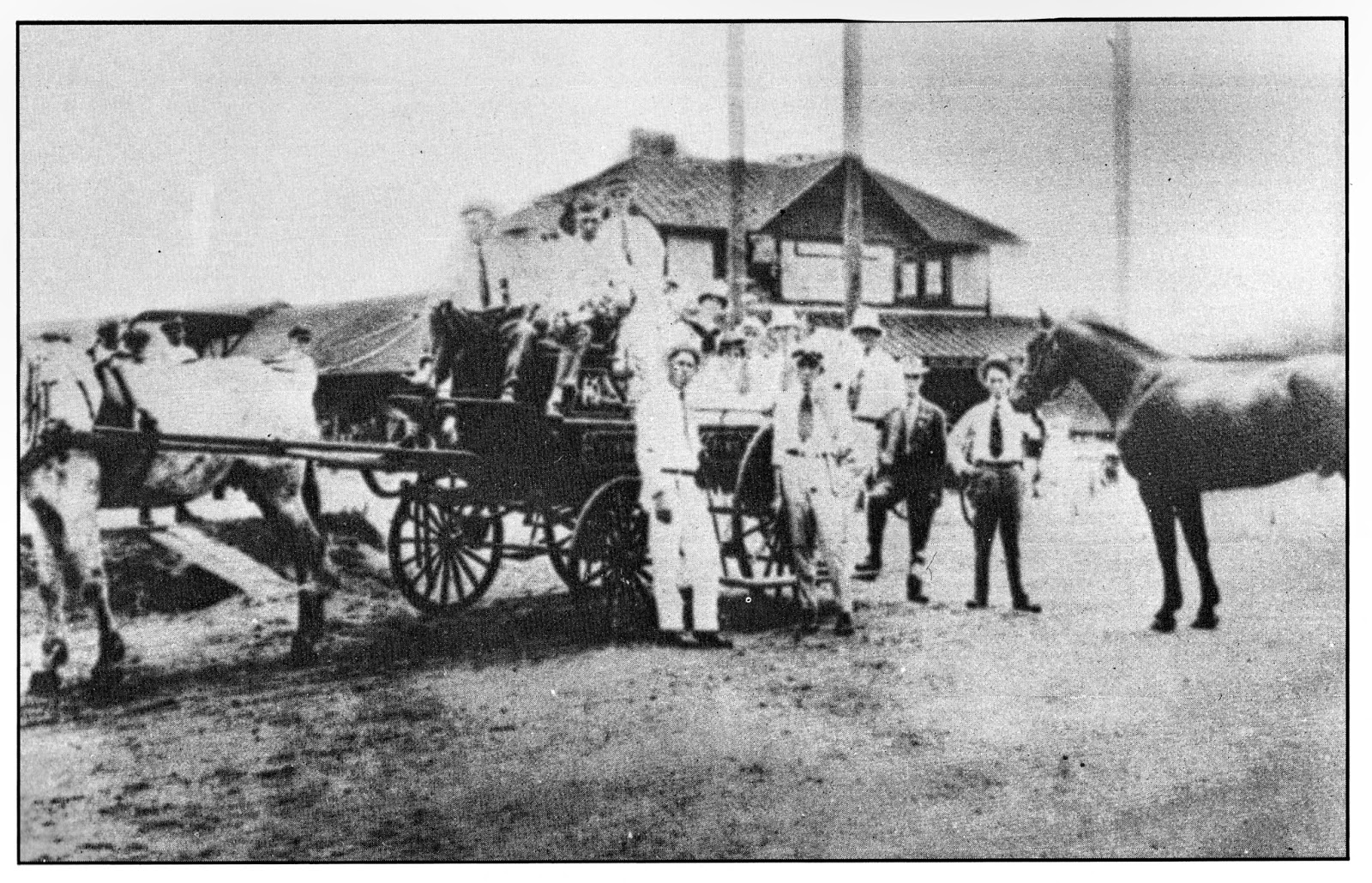
This presumably is "Our Pet," Kingstree's first horse-drawn fire wagon.
The Kingstree "fire laddies" won the horse at right in a contest in Orangeburg in 1910.
Source: Williamsburg County: A Pictorial History

In 1898, The County Record printed an editorial bemoaning the lack of a fire department in Kingstree. It noted that insurance rates were extremely high, so much so that it would soon be difficult to insure anything in the city limits of Kingstree. The paper argued that the amount citizens saved on insurance premiums would soon pay for the amount needed to set up a fire department.

No further mention of a fire department organizing is seen until 1901. On Friday evening, April 5, a large group of local men met at Brockington Drug Store on the corner of Main and Academy streets to form a local hook & ladder company, to be known as Kingstree Hook & Ladder #1. The men appointed W.R. Funk fire chief, with C.D. Jacobs as assistant chief. E.L. Smith was the company foreman, and attorney C.E. St. Amand was the secretary/treasurer. Dr. W.V. "Jack" Brockington would serve as surgeon.

A little over a year later, on July 10, 1902, lightning struck the stables and buggy house of Thomas & Bradham, located behind Barr's Hotel on Main Street, near the Courthouse Square. The fire was so large that it could be seen 10 miles from Kingstree, and only the direction of the wind saved the hotel for burning, as well. This fire was the catalyst for town council's adopting an ordinance regulating the construction of buildings and chimneys, particularly in the downtown area.

Two years later, on February 15, 1904, the Mt. Zion Methodist Episcopal Church, located on Main Street near the river was the victim of apparent arson. There had been a disagreement within the church, and it was felt that the arson stemmed from this. Kingstree's African-American chapter of the Odd Fellows had their hall next door to the church, and the fraternal organization agreed to allow the church to use its building after the fire. Then, on May 6, that building, as well as the school next door to it attended by the town's Black children also fell victim to arson. The Governor of South Carolina offered a reward for any information regarding the arsonists. These fires prompted the town council to build brick and cement reservoirs at the public artesian wells to help provide more water for fire suppression.

A few months later, on July 5, the stables at the rear of the Coleman House Hotel on Main Street caught fire, endangering the hotel. The bucket brigade sacrificed the stables to save the hotel and surrounding buildings. The County Record used this fire to push the town to buy a horse-drawn fire engine and to form a fire company, citing that now that the town had reservoirs, the next step should be the purchase of a fire engine. Town Council responded in early September by buying a fire engine which arrived at the end of the month. In October, council bought 500 feet of hose to equip it.

On October 18, 1904, Town Councilman H.A. Meyer held a meeting in the law offices of Stoll & Stoll to organize a fire company. Fifteen men enrolled in the Wee Nee Fire Company. Meyer was the President; Saul Marcus, Vice President; and Philip Stoll, Secretary. They were to have once a week hose drills, and Stoll was instructed to solicit more members for the company.

Six months later, in April 1905, W.W. Battiste's home on Hampton Avenue caught fire, pointing out the inefficiencies of the town's fire-fighting system. The new fire engine, which the firefighters had named "Our Pet," and the hose were hauled to the scene but a lack of water in that part of town made them ineffective. The bucket brigade was unable to save the Battiste house, but they were able to save the Episcopal Church next door, which caught fire in half a dozen places.


Hampton Avenue, with the Episcopal Church at left. The Battiste house
may be the yellow house beside the church in this photo.

The year 1906 ended with a massive fire on Main Street on December 31. All the buildings from the Courthouse west to Jail (now Jackson) Street burned. This included what was once Barr's Hotel, but was by then known as the Central Hotel and three other storefronts, including Dr. Wallace's drugstore. The County Record noted, "As usual, the engine "Our Pet" came prancing to the scene after the fire had burned itself out."

Several months later, on Monday, March 18, 1907, fire broke out in Meyer's Bakery at the rear of Scott & Miller's Market on the north side of East Main Street. The fire department was able to confine the fire to three wooden buildings between P.S. Courtney's store and the store owned by G. Ollie Epps on the corner of Main Street and Hampton Avenue. Three days later, the fire department re-organized yet again. This time, M.H. Jacobs was named chief, with W.E. James foreman of the nozzle; Tom McCutchen, foreman of the hook & ladder; and F.W. Fairey, pumping foreman. The Town of Kingstree agreed to refund the "foot tax" of every member of the fire department and to pay then $1 for every fire they worked.


M.H. "Uncle Monty" Jacobs
Source: Williamsburgh Historical Museum

In the summer of 1907, a gentleman named P.G. Howe was in town demonstrating his Howe Fire Engine which worked either by hand or with a gasoline motor attached. The town was interested in the machine, but apparently did not buy one.

On Sunday afternoon, May 18, 1908, a fire was discovered in Lesesne & Thompson's shop, located at the rear of Meyer's Bakery, which had relocated to the corner of Main & Academy streets after the March 1907 fire. The wooden building housing the bakery and Lesene & Thompson was destroyed, as was the general merchandise store of T.J. Pendergrass, one of the town's leading Black merchants.

A year later, on May 4, 1909, fire destroyed O.H. Patrick's home on Academy Street, prompting The County Record to note, "Anyone who was at the fire could readily see how badly Kingstree needs an up-to-date fire department with an available amount of water... and it is to be hoped that the city fathers will look into the matter in the near future."

In November of that year, the town was experimenting with a chemical fire extinguishing apparatus. It would not take the place of "Our Pet," the department said, but it could help contain fires until "Our Pet" arrived at the scene. The chemical engine got its first test when Young's Ice Cream Palace on Main Street caught fire. The machine worked very well, quickly extinguishing the fire, and in January 1910, Town Council bought two of the chemical engines for $500.

Saturday, December 17, 1910, started out as a busy Christmas shopping day in downtown Kingstree. Around mid-day, L.D. Rodgers was showing fireworks to a customer when one exploded, setting fire to the store and sending thick smoke belching from the building. The two chemical engines were employed and kept the fire from spreading until "Our Pet" arrived. Although not officially part of the fire department, a number of the town's Black residents worked tirelessly, pumping water from the reservoir into the hose to keep a constant stream of water directed at the fire. Several hundred spectators gathered, wondering if the newly-completed buildings that had replaced those lost in the fire of 1907 would also be reduced to ashes. The fire, however, was contained in the Rodgers store, and The County Record later noted that the reservoir at the well in the middle of the intersection of Main and Academy streets was instrumental in getting the fire out.


The James Brockington House at the head of Academy Street.

Almost a year later, shortly after midnight on Sunday, November 5, 1911, a Kingstree landmark was destroyed by fire. The old Brockinton home at the head of Academy Street was lost in a large blaze. The house was then owned by the Rev. W.S. Martin and rented by W.E. Jenkinson. Mr. Jenkinson was able to save the piano, but all other furnishings were lost, and he suffered a severely mashed foots for his efforts. The fire was so hot, that a number of trees in the yard were severely scorched, and it was thought that they, too, would not survive.

The next week, the Kingstree Fire Department again re-organized. This time it made notable structural changes. Although Black residents had joined bucket brigades and most recently operated the pump at fires, they had never been allowed to be a formal part of the fire department. The department now organized a Black fire company to be in charge of getting "Our Pet" to fires and making sure there was water to operate it.

During the early years of the community, the sextons of the three churches on Academy Street tolled the church bells as a fire alarm. Apparently, by the early 1900s, the means of sounding the alarm had become the shooting of pistols. However, as it was not uncommon to hear gunfire on the streets of Kingstree in the early days of the 20th Century, The County Record noted, "It leads one to wonder how residents distinguish gun shots used as a fire alarm from "sounds of disorder."


The Nettles Hotel, scene of a 1913 fire, is now known as the Marcus Building.

On January 31, 1913, the night policeman discovered a fire in the old Nettles Hotel above Jenkinson Brothers and Milhous & Jennings on Main Street. The Hotel, while still leased by S.A. Nettles, was no longer functioning as a hotel but was used for overflow from the Kellahan Hotel and was also used for storage. Several rooms had recently been rented by a family as housing. This would be the first test of the performance of the town's new municipal water system during a fire. Fifty thousand gallons of water were dumped on the fire, confining it to the old hotel, leaving the ground floor unharmed by the fire, although there was considerable water damage to the merchandise in both first-floor stores.


Firefighter Greg Ward dusts one of the fire trucks.


The Kingstree Fire Department will soon occupy its new building on Longstreet St.

Through the years, the Kingstree Fire Department has continued to make improvements and to grow. Today as the department prepares to move into brand new quarters, Chief Tim Duke has eight paid staff members and 29 volunteer firefighters. The Town of Kingstree has a Class 3 Insurance Services Office (ISO) rating, the impact of which is still seen in lower fire insurance premiums. The department answers between 400 and 600 calls a year, according to Assistant Fire Chief Jeremy Morris.