Tuesday, December 24, 2019

The End of an Era

Friday, Christmas Eve, 1915. It's mid afternoon in downtown Kingstree, and a number of farmers from out-of-town are hanging around in front of the three-story Gourdin building on Main Street. There's a sign on the door of the state-controlled dispensary on the first floor which says CLOSED UNTIL 5:30, and the men are hoping that this is true. Kingstree residents, however, are snickering behind their backs because they know that whoever put up the sign did it as a prank. Dispenser DuBose had sold his last pint of gin at 1 p.m., and when he locked the door behind him, all knew that it was for the last time. After 21 colorful years, the state dispensary system was finally history.


South Carolina Dispensary bottles showing various designs used.
Source: Treasure.net

The idea of the state having the monopoly on liquor sales was the brainchild of South Carolina's controversial governor, Benjamin R. Tillman. And if The State newspaper can be believed, Williamsburg County got the first two dispensaries, or at least two of the first dispensaries opened were in Kingstree and Greeleyville. The January 3, 1894, issue of The State reported, "Williamsburg County, which has been dry for a very long time, was the first to catch the state gin-shops." The reporter went on to note that this was very strange as Rep. E.R. Lesesne had made it clear that he only wanted one dispensary in the county at Kingstree, "and only wanted that one to be there in case of some emergency when liquors might be required for illness or something of that kind."


South Carolina Governor Benjamin Ryan Tillman.
Source: Wikipedia

It didn't take long for things to go crosswise for the Kingstree Dispensary. In late January, O.A. McDonald, who had been appointed dispenser, went to Columbia to pick up stock. However, as his bond had not yet been approved, he left empty-handed. A year later, in March 1895, McDonald found himself in hot water when the dispensary showed a shortage of $800. Newspaper articles speculated that it was well-known that McDonald had lost a large sum of money in a recent bank failure. The dispensary was closed for a week as investigators went over his books, and although the people of Kingstree solidly supported McDonald, he was replaced by R.R. Stutts.

At that time the dispensary was located on Academy Street next door to M.F. Heller's Livery & Sales Stable, in the area where The HomeTown Chamber and Miles & Co. are located today. On March 12, 1897, Stutts, who lived across the street from the dispensary, was robbed in a most mysterious fashion. He said he had arrived home just before midnight after attending a Masonic meeting, carrying $195 in cash and a $22 check, most of which belonged to the dispensary. The money was in his vest pocket, and he remembered putting the vest under his pillow before going to bed. However, the next morning, the money, check, his watch and chain, his double-barreled shotgun, his hat, five cigars and two one-cent pieces were all missing. Stutts said he believed the burglar must have come through the window and chloroformed him and his wife as they both felt "stupified" upon awakening. Neither of his two children, who were also asleep in the room, nor a boarder in another room were aware of anything out of the ordinary. There were no clues left at the scene.


1908 Sanborn Fire Insurance Map. The dispensary is the sixth building from the left
in the line of pink buildings on Academy Street.

But that was not the end of Stutts' troubles. In July, his reports showed that he was $473.50 short. Apparently, he simply paid the shortage, but on August 3, while inventorying his stock, he discovered several sealed cases of liquor that were actually empty. Enraged, he tracked down his 16-year-old brother-in-law, Peter Matthews, who had been working at the dispensary for about four months and confronted him about the empty cases. Matthews did not give Stutts a "satisfactory answer," and Stutts fired two or three shots at him. Although he did not hit him, the incident caused "quite a sensation" in town. Once again the board of control closed the dispensary to investigate. The investigators found 13 empty cases hidden underneath full cases. Stutts continued to blame Matthews, but was dismissed as dispenser. Again, the townspeople solidly supported him, and he was soon hired by the Kingstree Town Council to serve as Town Marshal, the equivalent of a policeman today.


The Dispensary would have been located in this area of Academy Street.

Ashby Mouzon, the dispenser at Greeleyville, replaced Stutts. During Mouzon's tenure, there were no problems reported at the dispensary. Sadly, Mouzon died suddenly in December 1899.

In early 1900, Frank Player was appointed to replace Mouzon. His troubles began shortly thereafter. In early April, the dispensary was burglarized after the rear door was broken open and $21 worth of liquor was stolen. After this incident, Player began sleeping in the dispensary at night; however, he would go home on Saturday night after he closed and return to open for business on Monday. In early September, another burglary occurred on either Saturday or Sunday night, as Player arrived on Monday to find the window pried open and $114.88 in liquor missing. 

A third incident occurred on December 28, 1900, when Player alleged he was robbed by four masked men who stole $1800 and 2 croaker sacks full of whiskey. He said he was sleeping in the dispensary when he heard someone calling his name from outside the back door. He opened it to find two masked men who demanded all the money in the safe. They were joined by two other men who filled two sacks with liquor bottles. 

Player said he was told not to sound the alarm until the men had time to escape or his life would be in danger. He waited for some time and then went across the street to awaken Town Marshal Stutts. Stutts would claim that he could hear buggies crossing the Black River bridge when Player came to get him. Stutts went to awaken H.O. Britton, who was jailer, but also served as clerk to the board of control, the local body that governed the dispensary. Britton instructed Stutts to wait with Player at Stutts' home until Britton arrived after daybreak and ordered the dispensary closed for yet another investigation.

The investigation turned up many irregularities that caused a round of finger-pointing among those in charge. Player, it turned out, had not been making regular deposits to the county treasurer, nor had he  been putting money overnight in M.F. Heller's safe as he had done in the past. In addition, Player's bond had expired on December 15 and had not been renewed. County Treasurer R.D. Rollins said he had spoken to Player about the lack of deposits, but Player ignored him. According to Rollins, Player had deposited only $285 for December. Rollins said he had notified Britton about that and about Player's bond expiration; Britton said he had taken the matter to the board of control, but other members had ignored him. Mayor W.H. Kennedy said he, too, had spoken to Player about the necessity of depositing money with the treasurer, but that Player had paid him no attention and that Britton, when he took the problem to him, had refused to back the mayor up.

Stutts claimed he knew who the robbers were, based on Player's description of one of their coats. However, he appeared to be in no hurry to search for them. This robbery was the largest to occur at a state-run dispensary. 

Player resigned the day afterward, and the board immediately appointed W.D. Crooks dispenser in what turned out to be a violation of state law, of which they were swiftly reminded by the state board of control.

The people of Kingstree were angry and demanded the removal of the members of the board of control. They were concerned about rumors that with all the trouble at the dispensary that year it might close permanently. The majority of funding for the school came from dispensary profits, and should it close, it would take a long time to find an alternative method for funding education, meaning that the school also would have to close. Replacing the board became a priority.


Kingstree Academy as it would have looked in 1900.

The investigators discovered that $2,030.49 was missing, and on January 5, 1901, Player was arrested for malfeasance in office. He was accused of selling liquor on credit and using dispensary funds to make loans to his friends. Player continued to insist that he was robbed, but he also confessed that he had made small loans to his friends. He was sentenced and served a portion of his term but was  pardoned in 1902 by the governor.

The dispensary remained closed until February, when it re-opened with J.W. Coward as dispenser. In May, Coward was called to Columbia to explain why he had more cash on hand than his accounts called for. Once this was straightened out, he ran the dispensary without further problem. In May 1901, the old dispensary building was torn down, and R.H. Kellahan built a new building for the dispensary on the same spot. From May until August, the dispensary operated from a building across the street, next door to Dr. D.C Scott's drugstore.

By 1905, there was much talk about prohibition. In July, groups across Williamsburg County met to organize opposition to the dispensary system.  By the autumn of 1905, it had become a hot-button issue, with the two Kingstree newspapers taking opposite sides of the issue. The Stoll brothers, owners of The Weekly Mail, were in favor of the dispensary; Charles Wolfe, owner of The County Record, was just as strongly in favor of prohibition.

A referendum on the issue in late 1905 saw Williamsburg County narrowly vote for prohibition. The State Legislature announced in 1906 that it would gradually phase out the dispensaries. Each county had to petition for another referendum, however, and Williamsburg County was unable to produce enough signatures to call for the vote. So, the dispensary stayed open. 

The question was again on the ballot in 1909, and this time Williamsburg County voted resoundingly for prohibition. Although heavy voter turnout was expected, it did not materialize, and county and town officials were concerned about how they were going to make up the $30,000 loss in revenue. The dispensary closed on November 15, 1909, and by 1912, petitions were circulating to call for a special referendum on re-establishing the dispensary in Kingstree.

The referendum was held in August 1913, and the results were unsurprisingly controversial. The case eventually made its way to the South Carolina Supreme Court, which ruled in April 1914 that Williamsburg County would once again have a dispensary. It opened July 14, 1914, on the first floor of the Gourdin building. In September 1915, there was another statewide referendum on prohibition. This time the vote was 565-132 that Williamsburg County prohibit the sale of liquor within its borders.


The Dispensary re-opened in 1914 in this building on Main Street.
When it closed Christmas Eve 1915, building owner P.G Gourdin remodeled the space into a bakery.

When the dispensaries closed for good in December 1915, some counties found themselves in a quandary about how to dispose of the leftover alcohol as it was now illegal to sell it in South Carolina. That wasn't a problem for Williamsburg County, as it was one of only two counties that completely sold out of its stock of alcohol before closing. 

Wednesday, December 18, 2019

Kingstree: Crown of the Black River

This week we're going to look more at history-in-the-making than at our historic past. For three days, December 10, 11, and 12, a team of five professional community planners and designers met with Kingstree residents and toured the town before coming up with a roadmap for the town's way forward. As part of this process, they crafted a branding statement to help us better tell the story of the community. At the presentation on December 12, Ben Muldrow, the world's leading expert on community branding, recited the branding statement. Reading it here will not match hearing the words spoken aloud, so I urge you to view the whole presentation here. But, if you only have time to listen to Ben's recitation, it starts at 11:22 in the presentation.


Black River from the site of the proposed Black River Landing.

Here is the statement:

We are Kingstree, South Carolina. For nearly 300 years, we have been crafting a colorful story, a story set on the banks of the Black River. In the shade of our grand white pine, by the fields filled with indigo, ours is a story of discovery. As the state's oldest inland community, our majestic Black River opened a corridor of exploration to South Carolina's Midlands. 

Ours is a story of excellence, as the strength and trueness of a lone white pine earned it the mark of the King. The broad point symbolized a royal protection and an intention of greatness.


The broad point is used to tell part of Kingstree's story.
Source: Ben Muldrow, Arnett Muldrow & Associates

Ours is a story of growth, as agriculture has always been in our blood. We are connected to the rich lands whose bounty provides us prosperity and whose beauty provides us relaxation.


Cotton has long been a staple crop in the area.

Ours is a story of humble greatness. Our men and women have become accomplished athletes, singers, statesmen, and even a Nobel Prize winner. Kingstree has truly been marked for excellence.


Dr. Joseph L. Goldstein, 1985 Nobel Laureate in Medicine.
Source: University of Texas

And though our story is rich with history, it is still being written. Entrepreneurs are opening new businesses. Investors are preserving our historic buildings.


Attorney Cezar McKnight recently renovated this building on Mill Street for his law office.

In our historic downtown, music fills the streets, and they come to life with events where the entire community gathers.


Community members dance with the band at one of last summer's Kigstree Live events.

And on the banks of our river, where the story began, we are starting a new chapter at Black River Landing.


A computer assisted rendering of what Black River Landing could look like.
Source: Randy Wilson, Community Design Solutions


Inside the existing building targeted to become The Shed at Black River Landing.
Source: Randy Wilson

We invite you to rediscover this amazing place we call home–this place where our rich history combines with our warm spirit to create an experience, much like our name, that is one of a kind.


Welcome to Kingstree: the Crown of the Black River.


Wednesday, December 4, 2019

The Revolutionary War Tales of Thorntree

As we established last time, James Witherspoon moved his family to Thorntree at its original location near the Black River about six miles from Kingstree in 1749. James himself lived there for only about 15 years, dying in November 1765. We can't be certain what happened between the time of James' death and the American Revolution, but we know from first-hand reports like William James' A Sketch of the Life of Brigadier General Francis Marion that by March 1781, James Witherspoon's oldest son John and his family were living at Thorntree.


Denley Caughman portraying British Lt. Col. John Watson during an "Afternoon at Thorntree."

In March 1781, British Lt. Col. John Watson planned to cross the lower bridge on Black River and advance toward the King's Tree. However, Gen. Francis Marion, who had been tailing Watson, found out about the plan, and when Watson's troops arrived at the bridge, they were met by a force of Marion's Men, including McCottry's Sharpshooters who picked off a large number of British soldiers. The Americans also burned the bridge, keeping Watson's troops on the far side of the river from the King's Tree.


Revolutionary War re-enactors portraying British troops occupy the front porch
of Thorntree on September 29, 2019, much as real British troops must have in March 1781.

Watson moved his remaining troops to the home of John Witherspoon in order to regroup and to lick their wounds from their defeat by Marion. The British troops took over Thorntree, although the Witherspoon family also remained in the house. By the day after the battle at the Lower Bridge, Marion's men had also entrenched themselves around the Witherspoon plantation, with sharpshooters either behind trees surrounding the house or in the trees lining the avenue to Thorntree.

As the British roamed around the property or lounged on the front porch of the house, Marion's sharpshooters constantly harassed them. One of the sharpshooters, Sgt. James McDonald, described as a big, red-haired Scot from the Williamsburgh Militia, drew a bead on British Lt. George Torriano, who was, some sources say, standing 300 yards from McDonald's perch in a live oak tree on the Witherspoon avenue. I might add that other sources say Torriano was lazing about on the piazza with his feet on a bannister, and that McDonald was perched in a hickory tree. Sources agree, however, that McDonald's rifle ball drilled through Torriano's knee, putting him out of commission.


Two re-enactors show the spectators a map, explaining the general vicinity of where the action
they are describing took place.


After this attack, Torriano and others of Watson's men who were in the house began making insulting remarks about Marion and his men, including Capt. Daniel Conyers, who had just made a brief appearance on horseback in a clearing not far from the house. John Witherspoon's daughter, Mary, was engaged to Daniel Conyers, and naturally took offense when she heard the British making these insolent remarks about him. But Mary took more than offense. She took action. Removing her walking shoe, she walloped one of the British officers about the face while exclaiming, "There's Capt. Conyers now. Go out and fight him, you coward!"


Re-enactors lounge on the porch of Thorntree, much as the British must have done in 1781.


As Marion's men continued to assault the British, later that day Watson decided to move down the road to Blakely Plantation. There, however, they were forced to camp in an open field. Marion's snipers followed them at a distance and continued to harass them once they set up camp, keeping them in such a panic that Watson ultimately decided to move on to Georgetown. Marion's men pursued them, turning back only after the British crossed the Sampit River.


Denley Caughman, as Lt. Col. Watson, stands on the porch at Thorntree, much
as Watson must have done in 1781, while making the decision to move on.

Earlier this year, on September 29, Dusty Owens, Denley Caughman, and other re-enactors presented an Afternoon at Thorntree, describing the American Revolution in Williamsburg County–but from the perspective of the British and from those who lived in Williamsburgh District, but who remained loyal to the King. Williamsburg County residents are fortunate to have a place like Thorntree that witnessed events like those described and in which we can re-live those moments in our community's history.


Wednesday, November 27, 2019

Thorntree Likely Oldest Standing Pee Dee Residence

Last time we looked at the family of John Witherspoon, one of the first settlers of Williamsburg County. James Witherspoon, one of John's sons, is perhaps the best-known of the Witherspoon descendants to Kingstree residents because of the legacy he left us in the form of his home, Thorntree, the 270-year-old house that now stands on Nelson Boulevard in Kingstree.


Thorntree as it looks today.

James Witherspoon arrived in Williamsburg County in December 1734. A month later, on January 11, 1735, he received a 300-acre land grant near Black River, located about six miles from the King's Tree. Fourteen years after that, in March 1749, Witherspoon moved his family to a home he had built from trees that had grown on his land grant. This home was known as Thorntree.


The rear view of Thorntree.

Upon James Witherspoon's death in 1765, it appears that his oldest son, John, lived in the house. We know his family was living there in 1781 during the American Revolution. He died in 1805, and the property must have passed to his youngest brother, Gavin, for in 1816, Gavin's heirs sold Thorntree Plantation to John A. Gordon. John W. Gordon then inherited the plantation, selling it to Daniel Hicks Hamer in 1883 when Gordon moved to Alabama. One of Hamer's sons was a principal in the Hamer-Thompson Overland car dealership, which began in Salters but later opened a branch in Kingstree. Thorntree, however, was inherited by D.H. Hamer's youngest child, Mattie Jane, who married James Alurid Farrell. When she died, their son, also James Alurid Farrell, inherited the property. He was using it as a tenant house when its history came to the attention of the Williamsburg Historical Society in the late 1960s.

On May 21, 1967, Elizabeth White wrote in The State newspaper, "An exciting example of 'memory work' architectural detail in cornices, mantels, and moldings has been discovered in a weather-beaten home in Williamsburg County."


Mantel and molding in one room of Thorntree as it looks today.

The article noted that the detailed carvings on the cornices, mantels, and moldings were called memory work because they were created without patterns from the craftsmens' memories of designs seen in their homelands. Meyric Rogers, a museum curator who had assisted in the restoration of the Ainsley Hall House in Columbia, and who was called in to give his professional opinion of Thorntree, noted, "The house in architectural structure is a rarity." He also noted, "There is not another house of its type–unless along the James River in Virginia."


Another fireplace, which showcases more "memory work" on the mantel.

Survival of pre-Revolutionary War homes is rare, as they were either destroyed by the British or torn down and rebuilt as their owners became more prosperous. Thorntree escaped the former as it was used by British Colonel John Watson as his headquarters for a short time during the war. James Witherspoon died before the American Revolution, and his heirs apparently saw no need to modernize by building a new house.

When it was "discovered" in the late 1960s, historians marveled that the cornices and mantels were original to the house and still in good condition. Shed rooms and a side porch, added probably around 1800, were then part of the house.


Thorntree as it looked with the shed rooms and side porch still attached.

J.A. Ferrell agreed to give the house to the historical society, provided the society built him another tenant house. The society also decided to move Thorntree to land donated by Marie L. Nelson in Kingstree where the house would get the benefit of police and fire protection.

On December 3, 1969, Thorntree, with the shed rooms and side porch removed, was slowly brought down Highway 377 to Kingstree from the place where it had stood for 220 years. Leverne M. Prosser, writing in the News & Courier on December 4, 1969, noted, "The house, for the most part, was put together with wooden pegs, and each of its main structural pieces was specially shaped to fit together like a jigsaw puzzle. The original wood was hand-hewed." Designated as the oldest known residence in the Pee Dee area of South Carolina, it was listed on the National Register of Historic Places on October 28, 1970.


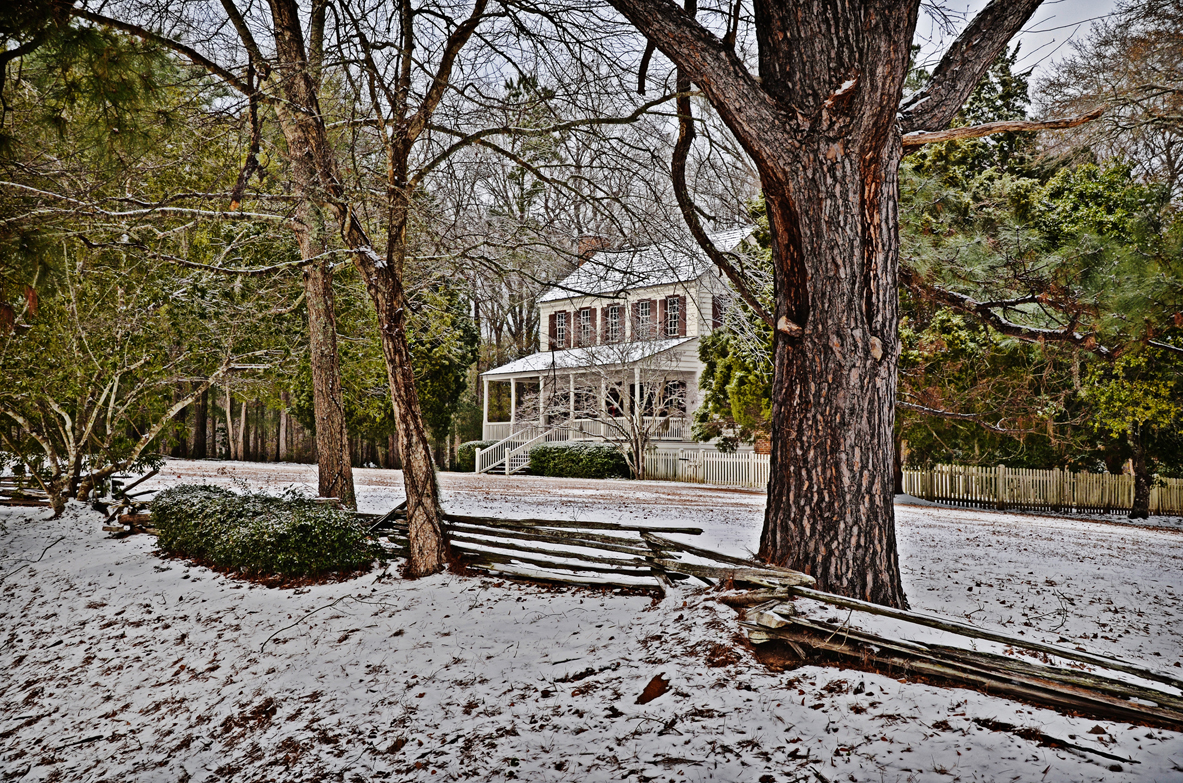
Thorntree in Snow, 2011.

Restoration of Thorntree was Williamsburg County's contribution to South Carolina's Tricentennial Project in 1970. Plans were to restore Thorntree and develop the Fluitt-Nelson Memorial Park where it sits to recreate the conditions of Colonial times with both indigo and flax growing on the property. There was also a proposal to create a lake on the property, landscaped with wildflowers, trees, and shrubs.

On April 2, 1971, Thorntree and the Fluitt-Nelson Memorial Park were dedicated. For the next several years, Thorntree was open from 2:30-4:30 on Sunday afternoons every month except January and February, and on one weekend in December, it was open both Saturday and Sunday evenings for a Candlelight Tour, showcased as an 18th Century Christmas Celebration. Admission in December 1971 was $2 for adults, $1 for children. The Candlelight Tour was advertised in daily newspapers across the state as "blazing fires, spicy pomander balls, wreaths, holly sprigs and cedar garlands will grace the interior of the old plantation home of James Witherspoon who first came to America with his family in 1734." By 1977, a wassail bowl and fruit wreaths were also advertised as part of the festivities.


Another snowy view of Thorntree, this time in 2014.

In October 1982, Thorntree played a pivotal role in the celebration of the 250th anniversary of Kingstree's founding. Thorntree was the site of a Revolutionary War encampment by the Second SC Regiment. Also that weekend, Peggy McGill's folk opera, "Williamsburgh," directed by Doreen Welch, was performed in the space that six years later would be renovated into the Williamsburg County Auditorium. In addition, Williamsburg Technical College hosted a lancing tournament that weekend.

By the 1990s, Thorntree was open for tours by appointment and on special occasions for events. This is still true today.


A group listens to a presentation by Kingstree author Bubber Jenkinson.

Tomorrow, November 28, will mark the 251st anniversary of James Witherspoon's death. It is remarkable that his home has survived him by 251 years. However, Thorntree itself is now in need of repairs. As many of you are aware, the Williamsburgh Historical Society operates solely on memberships, donations, and the occasional grant. So, this holiday season, if you'd like to give the community a gift, consider making a donation to the Thorntree repair fund. You may make your checks payable to the Williamsburgh Historical Society, but please note somewhere that you would like the money used for Thorntree repairs. The address is Williamsburgh Historical Society, 135 Hampton Ave., Kingstree, SC 29556. Thorntree has weathered 270 years. Your contributions can help it stand for maybe 270 more.

Coming Up: The thrilling Revolutionary War stories associated with Thorntree.