Wednesday, May 20, 2020

Tales From the Early Kingstree Police Department

Later this year, Kingstree Police Chief Andre Williams and his 14 officers will move into their new headquarters next door to Town Hall on Longstreet Street. 


Work is ongoing on the new Kingstree Police and Fire Departments.
This is the new police station.

The police department has come a long way since the town's early days. The first census in which we find anyone's occupation labeled as "police" was in 1880. In that census, both George W. Arms and William Blakely listed their occupations as "police." Arms was white; Blakely was mulatto.

By 1893, Arms was serving as the county's jailer as well as the town marshal (the title used instead of policeman at that time). His duties were usually routine patrol, but there were those cases that found space in the newspaper even then. For example, in July 1897, Arms arrested Lowry "Nunky" Pierson and charged him with throwing rocks into an excursion train that had passed through Kingstree on June 22.

By the late 1890s, Richard Stutts had become town marshal, with J.B. Lemmon serving as his assistant.


Fire Chief Tim Duke, Police Chief Andre Williams, 
and Town Council Member Chris Williams at the
groundbreaking for the new police/fire complex 
in November 2019.

B.H. Myers was hired as Town Marshal by the town council in January 1901. Myers also operated a boarding house in Kingstree. He, too, made some interesting arrests, including that of a local carpenter who was described by the newspaper as "pursuing an erratic orbit on the sidewalks and swearing like a pirate." That unfortunate gentlemen spent 30 days on the chain gang for his troubles.

The summer of 1901 was a hot one, and the long, 102-degree days seemed to bring out the worst in the town's youngsters. Myers arrested one small boy, described as having "an abnormally developed bump of combativeness" for having pulled a knife on a playmate during a game of marbles and for giving "vent to his Vesuvian passion in a choice vocabulary of 'cuss' words." In Mayor's Court, the boy was given a choice of "40 stripes, save one" or time on the chain gang. He chose the 39 lashes, which were administered by his father at the jail, where the youngster spent the night to "meditate on the consequences of his conduct."

Six other small boys were hauled before the mayor after they were arrested for playing baseball in the street, which had recently been outlawed by town ordinance. Mayor W.H. Kennedy gave then all a severe reprimand and sent them on their way.


Today's police officers work hard on building good relationships in the community.
Here Chief Andre Williams tests his skill during last May's Kingstree Live.

The town council decided in October 1901 to hire a night marshal. The council interviewed five men for the position, including the current day marshal Myers; former marshal G.W. Arms; J.B. Lemmon, a former assistant marshal; J.P. Nelson; and James Tharpe. Myers, Arms, Lemmon and Nelson were white; Tharpe was black. Council hired Myers. The night marshal was to work every evening and all day Saturday for a salary of $7 per week.

In January 1902, Myers was called to break up an altercation between brothers, Jubal and Clarence Scott, which they were attempting to settle with an axe. Jubal fled to the swamp when Myers arrived. He was pursued, quickly apprehended, and brought back to the scene. By this time, a crowd had gathered and some in the crowd began making "unnecessary comments." Myers put an end to that by knocking several of those making the offending comments to the ground.

After 15 months of service, in April 1902, Myers resigned the position after a disagreement with town council. Myers had been paid by the owner of a store which had closed pending litigation to watch the store at night. Council contended that this was a regular part of the night marshal's job and would not allow him to accept the money from the owners. Myers said he had not charged the owners, but that they had given him the cash as a gift.


At last June's Kingstree Live, John Thomas Thompson found himself "captured"
by Kingstree Police officers Kirby and Cooper.

S.C. Anderson was hired to replace him at a salary of $30 per month. In addition to his work as a police officer, he was also to be in charge of lighting the streetlights every night. The County Record noted that Anderson arrested a woman "for overindulging in booze and attempting to give an open air matinee on Railroad Avenue." Mayor J.A. Kelley fined her $2, which she cheerfully paid before going on her way.

After five months as marshal, Anderson resigned to become manager of W.R. Funk's brickworks. He was replaced by J.A. Scott, who resigned after only a month on the job. Council rehired B.H. Myers as day marshal and his son, Charles, as night marshal. Before the end of the year, B.H. Myers, once again resigned, and council again hired J.A. Scott.

By 1905, S.C. Anderson was again town marshal. In October of that year, he discovered a thief in Wilkins' Retail Store between midnight and 1 a.m. He quickly recruited several townspeople to surround the store, but the suspect broke out the front door and escaped. The thief had filled two valises with merchandise, which he left in the store in his hurry to escape. The $23 taken from the cash drawer was not recovered, however.


At Blocktober Fest, KPD officers kept order but also found time to join 
the crowd in a little line dancing.

One of the more amusing incidents in early downtown Kingstree occurred on the evening of Monday, December 13, 1909. W.H. Carr, manager of Kingstree Hardware, was notified that evening by the night marshal that the door to Kingstree Hardware, then located on Academy Street, was standing open. When Carr arrived at the store a few minutes later, he found the door closed and locked. Mystified, he entered the store and discovered $3 missing from the cash drawer, as well as several items of merchandise and a pistol belonging to one of the town marshals which had been brought in for repair. He also noticed that the keys to the vacant building next door were missing. Still puzzled at how the thief had gotten into the store, Carr began experimenting and soon discovered that the same key opened half the stores on Academy Street, as well as several on Main Street. The next morning Kingstree was a busy place as storekeepers rushed to change their locks.

By 1915, J.H. Epps was police chief, with J.A. Scott and W.W. Dennis as officers. However, the three-man police department did not last long, as it was back down to the chief and one officer by 1919, and it remained a two-man operation well into the 1930s.

From January to March 1935, businesses in Kingstree found pennies missing from their cash registers. Finally in early March, a 30-year-old man, when confronted by the Kingstree Police, confessed that since the first of the year, he had entered a number of businesses and removed pennies from the cash registers, simply because he liked pennies. He said he had taken pennies from the wholesale division of the Kingstree Grocery Company, the Kingstree Service Station, Miller's Market, and the Dixie Garage, as well as from Wakim's Store twice and the Atlantic Coast Line Depot three times. These, he said, were all the places he could remember, but there might have been more.


The Kingstree Police Department, late 1950s or early 60s. Seated from l-r, S.L. McFadden, Chief
George B. Hammet, Orion Williams. Standing, F.D. Wheeler, George H. Roark
J.O. Strong, W.B. Cook, Cecil White, and A.A. Bracey.
Source: Williamsburg County: A Pictorial History

As the town grew, so did the police department. By the late 1950s, the police force consisted of nine officers.

The police station on Mill Street suffered irreparable damage during Hurricane Hugo in 1989. The police moved into the old Highway Department building behind the new town hall on Longstreet Street, with the promise that those arrangements were temporary and that a new police station would be built. Thirty-one years later that promise will finally become a reality. Monday night town council voted to name the new facility the Richard L. Treme Public Safety Complex in honor of the town manager, who happened to have been police chief in 1989. For Richard Treme, Chief Williams and the rest of the Kingstree police officers, the new building is a long-deferred dream come true.


Wednesday, May 6, 2020

County Considered Demolishing Courthouse in 1937

Kingstree residents of today should be grateful for another former resident, Nell Flinn Gilland, who used her considerable writing talent to preserve some of the history of Kingstree and Williamsburg County. She was the daughter of John William Flinn, a professor of philosophy and chaplain at the University of South Carolina. She moved to Kingstree after her marriage to Louis W. Gilland, an attorney and former mayor of Kingstree for whom Gilland Memorial Park is named.


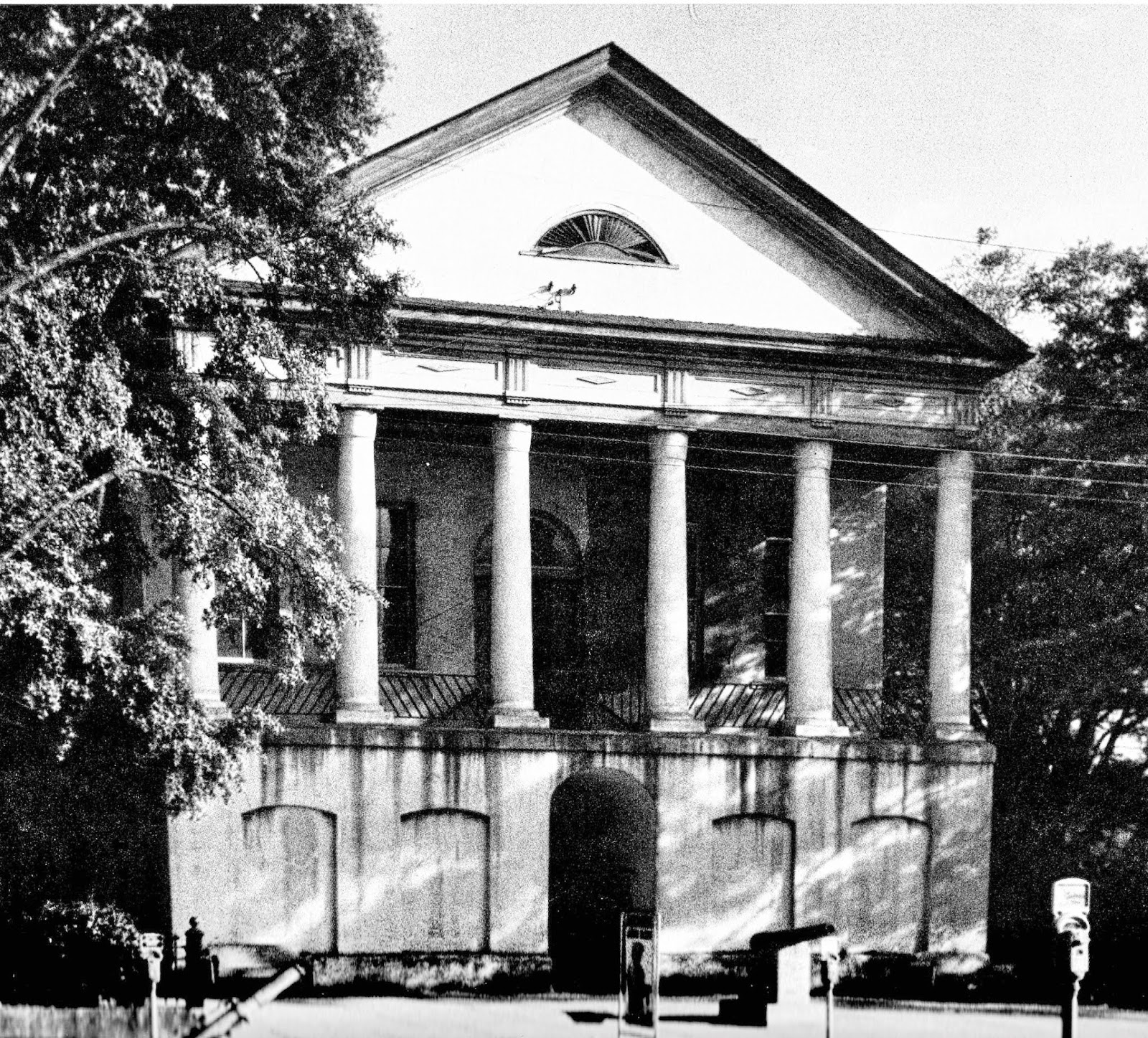
The Williamsburg County Courthouse as it looks today.

The following story, written by Nell Gilland, was published in the October 3, 1937, News & Courier.

"A central depository at the University of South Carolina for the preservation of courthouse records no longer in use was authorized by an act signed by Governor Olin D. Johnston during the last session of the legislature.

"This act grew out of concern felt by those interested in seeing that South Carolina should not lose by destruction due to indifference or lack of space valuable state material. In the past, fire, war, and unawareness of the value of records have caused irreparable loss of data which never can be replaced. The new wings which will be added to the fine old library building at the university will offer room for filing the state's records.

"Williamsburg, Colleton, and Spartanburg delegations introduced bills to secure permission to destroy old records on account of lack of space. It was this proposed legislation which aroused the university to offer to become custodian of unwanted records either temporarily or permanently.

"Chester, Barnwell, and Edgefield counties have added fireproof annexes, like the head of a "T" across the rear of their old courthouses to provide space for records and in an effort to preserve the beauty of the architecture of their honored courthouse buildings. Georgetown has built an annex in the courthouse grounds for offices and records, thus not interfering in the slightest with the form of their old buildings.

"In Williamsburg County there is a movement afoot either to add to the present building, build a new one, or make some other provision for needed space and modernization of offices.

"It would be tragic should the present historic courthouse in Williamsburg suffer demolition, and many citizens of the county feel that even the addition of an extension or wings might interfere with the beauty of the building, which stands as a monument to the skill of South Carolina's distinguished architect Robert Mills. With the massive columns and portico typical of Mills' architecture, the building is of classical design with walls thirty inches thick and has been occupied since 1823. In 1883, (newspaper articles from 1889 prove this date to be incorrect) the second story of the building caught fire and burned three days. But the offices in the vaulted ground floor proved fireproof and were occupied by officials before the flames upstairs were quenched, the records being quite safe.

"Williamsburg became a circuit court district by act of 1804. It was then the intention of the county to erect a courthouse on the public parade ground, which had played an important part in the history of the county since its first settling in 1732. But with the irregularity which existed in early days, William Brady had built a house on the site and claimed the lot. After his death (in 1820), the commissioners regained possession of the parade grounds for the county, and $10,000 was appropriated by legislature for the building.

"The late J.J.B. Montgomery, for many years county auditor and whose son, Donald Montgomery, has succeeded him to that office, used to tell how many of the earliest courthouse records were lost in an effort to save them from destruction at the hands of Sherman's army. In anticipation of the of the enemy's approach, record books were collected hastily and not too wisely entrusted to wagons to be carried off to Sumter and Camden for protection.


Former Williamsburg County Auditor J.J.B. Montgomery, known to all as "Daddy" Montgomery.


Donald Montgomery, who followed in his father's footsteps as county auditor.

"Some arrived safely at their destinations, but others were spilled along the wayside. In later years, a book of Williamsburg County records would turn up every now and then in some church along the route presumably taken by the emissaries. Mr. Montgomery said it was assumed that such books had fallen from the wagons unnoticed by the drivers and had been afterwards picked up and taken into a church for safe keeping. Some were irrevocably lost.

"It is the accumulation of records since that time which now are a problem. Office space also is inadequate, and the heating of the old building is accomplished by quaint open grates in the basement offices and by stoves in the courtroom. County officials are faced with the problem of effecting modern convenience and space without destroying or defacing a landmark which is a pride to the entire state.

"The courthouse grounds in Kingstree have recently been landscaped as part of the WPA beautification project, greatly enhancing the beauty of the old building set amid spreading oaks. An outdoor stage has been arranged for May Day festivals and other occasions with a lily pool between the stage and the audience.

"On these grounds the Craven County regiment held its parades and gala days two centuries ago, and here during the Revolution, the men of Williamsburg met when they came from every corner and by-way of the county to form themselves into four companies under the leadership of Major John James and became the nucleus of Marion's Brigade.

"During the days of the Confederacy and in the years of Reconstruction, the courthouse grounds were the center of patriotic gatherings. The World War saw the descendants of Marion's Brigade again mustering in at their country's call to arms. And not only in war, but also in peace, the courthouse and its grounds have seen the history of Williamsburg made. Fiery political gatherings have been held under the shade of the trees in the shadow of the building. Citizens have met to discuss local problems there, and meetings designed to disseminate among the people valuable information, as to improved farming methods have brought the people of Williamsburg to its courthouse as a shrine. Tourists and visitors from many distant states have stopped to admire the stately building.

"However present officials meet their problem of needed additional space, the beautiful courthouse stands, mutely testifying to its ancient dignity, its wealth of historical tradition."

The courthouse, of course, was not demolished, and 17 years after this article was published, an addition was added to the rear of the courthouse, and changes were made to the front entrance to the courtroom.

AND ONE MORE THING:

An early addition was apparently added to the courthouse in 1854. A classified advertisement in the February 18, 1854, issue of the Charleston Courier states: To Contractors and Builders–The Commissioners of Public Buildings for Williamsburgh District will receive sealed proposals on or until the 10th day of March next, for building an ADDITION TO THE COURTHOUSE, 16 feet in length and of the same width and height as the present building. Also for building new roof, removing present Jury rooms, gallery and four pillars placed there to support the present roof. For particulars as to plan and specifications, contractors are requested to address or call on Col. N.G. Rich, Kingstree, South Carolina, by whom the desired information will be given.
D.M. MASON
Chairman, Commission of Public Buildings

Wednesday, April 22, 2020

Robert Mills' Legacy in Stone and Wood

While many people know that the Williamsburg County Courthouse was designed by Robert Mills, few understand how important he was to American public architecture. In the March 3, 1929, issue of The News & Courier, Laura C. Hemingway took an in-depth look at Robert Mills' career, including interesting commentary on the Williamsburg County Courthouse. Laura Cromer came to Kingstree from the upstate in 1913 as principal of the graded and high school. After marrying Dr. Theodore S. Hemingway on October 9, 1915, she wrote many interesting articles, usually on local history, which appeared in newspapers and magazines around the state. Here is her story on Robert Mills:


The Williamsburg County Courthouse prior to 1954.
Source: Robert Mills's Courthouses and Jails

A century in the Mother country is a short period of time in architectural cycles. There buildings stand for ages to increase in charm as the years roll by. In America it is the reverse. Few houses of any kind first erected in this country have been left to bear testimony to the influences of the architecture of other countries and other ages. This is due principally to the ever growing demands of progress in the new world.

But all over America now antiques are gaining recognition from the observant and discriminating. Old furniture has been reclaimed from attics; ancient bits of glass have been brought to the light of day once more; and whereas a generation ago an old building was ruthlessly torn away to make place for one better fitted to suit the needs of an increasing population, sentiment and appreciation have begun to reach forth detaining hands and rescue many of these from destruction.

As the nation settles down to peace following a war, it is inevitable that certain students of this esthetic in architecture, as well as in other things, should awaken to the fact that here in America may be found structures that do credit to any nation. Recognition of such may be attributed to a number of things. Chiefly, it would seem to the increasing system of roadways and every growing number of automobiles. No longer is the American public content to sit beside its fireside. When the snows of the North become too heavy, a stream of tourists begin their southward trek. And when the southern summer sun beats to mercilessly upon the natives, they, in turn, are ready for their pilgrimage to mountains and lakes.

And thus it is that "one touch of nature makes the whole world akin." People want to know facts now as perhaps they have never wanted to know before. They all but demand the marketing of historic sites. They seek out odd corners where heroes lie buried. And they notice distinctive buildings and enquire as to the age of such and the origin.

Few men left more monuments to their names in the concrete form of stone and wood than did the architect Robert Mills. Planat's Encyclopedia d'Architecture and also the Dictionary of Architecture, both issued by the London Architectural Society, allot more space to Robert Mills than to all other American architects combined. Yet, in spite of his foreign recognition, and of the fact that he designed more public buildings and monuments in this country perhaps than any other one architect, his name has been all but forgotten by the latter generations. Although he was a prolific producer of plans and designs, he rarely placed his signature to any. For that reason, others have been given credit for the work he has done in more than one instance.

Robert Mills was born in Charleston, South Carolina, August 12, 1781, and died in Washington, D.C., March 3, 1855. He was the son of a Scotsman, William Mills, of Dundee, who came to America in 1770. Robert Mills' mother was Ann Taylor, a descendant of Landgrave Thomas Smith, provincial governor of South Carolina in 1690.


Robert Mills

He received his education at Charleston College. About 1800, he became associated as an apprentice with James Hoban, a Charleston architect who maintained offices in Washington, D.C. and who designed the White House. Young Mills was sent to Washington, and it was there he met Thomas Jefferson, who instantly became interested in the young architect from the South. So interested was Mr. Jefferson that he invited Robert Mills to visit him at his estate at Monticello. While there, Mr. Jefferson decided to build the mansion and so great was his confidence in the ability of Mills that he assigned the drawing of the plans to him, preserving for himself only the details.

It was probably while on this extended visit to Monticello that he met Miss Eliza Barnwell Smith, daughter of General Smith of Hackwood Park, Virginia, who later became his wife.


Robert and Eliza Mills.

Mills must have been an indefatigable worker if one would judge by the number of worthwhile places designed by him in the vast expanse of territory. This ranged from South Carolina up through Washington, Philadelphia, Baltimore, New York, and out as far as New Orleans. And that more than a century ago when travel was tedious, long, and drawn-out.

In addition to his architectural work, he was a prolific writer along reformative lines. Strange though it is, in this he seems to have been a prophet without honor in his own country. Latter years have brought to pass some of the issues for which he advocated, but during his lifetime, he seems to have received more censure than praise.

He possessed a keen insight into the economic conditions  of his home state and tried to lift up his voice to bring about an era of prosperity established upon sane and safe principles. Whenever he offered a suggestion for the betterment of conditions, he accompanied it by practical working plans. He was an advocate of river and canal development in South Carolina, this to continue across the mountains to the Mississippi River, eventually to become a network for inland navigation. Taking the Broad River as an example, he said:

"To the lover of his country, the head of this river induced a most interesting train of thought, and when he ascends the mountains where the western branch of the Broad (there called Green) River intersects it, he will behold the waters of the extremes of the Union almost interchanging and inviting the hand of industry and art to unite them–unite us and you bind the political destinies of your country in bonds of indissoluble peace and prosperity."

Mills further proved himself a prophet in predicting the "steam carriage" as a forerunner of the automobile in his Substitute for Railroads and Canals, published as early as 1834.

But in nothing, speaking in economic terms, was he so interested as in the reclamation of his native lowlands. In his Statistics of South Carolina, he declares:

"Independent of the incalculable benefits which would result from it in points of health and comfort to the inhabitants, the finest lands of the state would thereby be brought in cultivation, and the way opened for increasing the population of this section of the state, thus adding to the physical power of the country."

Mills Atlas of 1825 contains individual maps of the 28 districts of South Carolina. Produced from a special appropriation of $64,670 during the period of 1816 to 1825, these maps are signed by 22 surveyors. Only those of Darlington and Marlboro were left unsigned. These were probably the work of Robert Mills.


Charles C. Wilson, architect of Columbia, to whom the writer of this article is indebted for an unlimited supply of information concerning the subject of this sketch, says in speaking of these maps, "I have had occasion in the cause of my practice to test the accuracy of these maps by extensive and precise surveys in thirteen of the twenty-eight districts, and I have yet to find the first material error or omission. Every stream, lake, road, hill, swamp, or other permanent landmark I have found to be exactly as represented, and no surveys or maps haves since been made which will compare with this work of a century ago in completeness or precision."

In architecture, also, this same thoroughness and precision is so noted that the stranger in passing one of his buildings is quick to notice something distinctive about it and begins to make inquiries concerning it.

In the Charleston Courier of February 18, 1822, Mills' signature appears over an advertisement for proposals for building court houses at Greenville, York, Newberry, and Kingstree. Of these four court houses, all of which were similar in design, only one is left today. That is at Kingstree. This is still in use as originally planned. It is typical of Mills' style, showing its "massive Greek Doric" columns rising from a second story vestibule to the portico roof. It may be said that his characteristic, the portico and massive columns almost invariably found upon his public buildings, is Mills' signature, which he seemed averse to signing with pen. It was unnecessary!

Edward Hooker in his diary of 1808 spoke of such columns rising from the area of the chapel at the South Carolina College, now the University, with "considerable majesty, giving the room an appearance of grandeur." This is the impression left upon the minds of tourists passing through Kingstree when they view the old court house, standing in stately dignity among its live oaks on its expanse of green sward opposite the hotel. Officials within this house of justice claim that strangers frequently come there seeking to know something about this classic building. And strange to say, they have been turned away uninformed, for this work of architectural art has simply come to be accepted as "one of the old houses" of Kingstree!


Columns and portico of the Williamsburg County Courthouse today.

As it is typical of others designed by Mills, it is not amiss to give it some detailed description. Its original proportions are perfect. Two stories in height, the first floor being built on a level with the ground. Through the center runs a corridor with a vaulted ceiling of considerable height, and with a paving of slate flagstones for a floor. Where these flagstones came from in that day when the carriage of such was no easy matter has never been satisfactorily determined. It is generally supposed they were brought over from the Mother Country. Certain it is that they do not abound hereabout.


A view of the vaulted hall ceiling through the door of the Courthouse.

On each side of this corridor are the office rooms. These are well-proportioned, having vaulted ceilings and recessed windows or French doors, some of which still retain their heavy inside bars. The floors are concrete. The second story, or court room, is reached over outside stairs at the end of the portico. The steps are deep slabs of solid slate stone. They bear evidence of more than a century's wear, and therein lie many stories for the imaginative. The balcony has a wrought iron railing across the front.

Certain of the older citizens in Kingstree remember this building catching fire and burning the roof. Valuable papers were removed to safe quarters, it being feared the building would be destroyed. But evidently those of that generation were not acquainted with Mills' hobby to make his buildings as nearly fireproof as possible. After several days, the officials realized the building would not burn, and the papers were restored to their shelves. However, it is said that certain old documents have never been found since the fire. They were possibly destroyed or misplaced.

So fireproof was Mills' work that he was chosen to design two fireproof wings to Independence Hall in Philadelphia. This he did, not varying the style of architecture an iota, in 1810, while he was still under 30.

The walls of the Kingstree courthouse are of solid brick 30 inches thick. Two rooms across the back have been added in recent years, but this was done in keeping with the original architecture. In 1884, the building underwent minor remodeling. A stucco outer surface was given the brick. Near the arched entrance to the lower story is a tablet bearing the names of the commissioners at that time. These are J.W. Gamble, G.P. Nelson, and S.I. Montgomery. The contract for the building was given to a Mr. Hoover from North Carolina. At the same time he constructed in the Cedar Swamp section a commodious residence for John Ervin Scott, father of Dr. D.C. Scott. His work bears the earmarks of sustainability.

The remodeling following the fire was under the direction of J.K. Gourdin, an architect of some note in his day. He was accorded considerable notice in his profession by his remodeling of St. Michael's church following the earthquake. Certain parts of the brick walls had been thrown out of line. Mr. Gourdin succeeded in reclaiming them with no material damage to the structure.

Kingstree's courthouse is built upon the early muster grounds. The titles were held up for some time due to the inability on the part of those in authority to remove from the premises an old "squatter." it was after his death that clear titles were secured to the entire plot.

The courthouses in York, Newberry, and Greenville designed by Mills in 1822 have been replaced by modern ones of more imposing structure to meet the progress of the 20th century. The original building in Greenville has been attributed for many years to Joel R. Poinsett. This due, perhaps, to the fact that Mills was associated with Poinsett and Abram Blanding on a Board of Public Works about the year 1820. When this building was torn down a few years ago to make room for the 10-story Chamber of Commerce, many who were interested in its origin hoped some light might be thrown upon it by means of the contents of the cornerstone. There was no cornerstone. All the more evidence that Mills had designed the building. There, too, were the usual side steps rising to the upstairs portico. The iron railing along these steps, it is said, was designed and made by Mr. Cauble, Greenville's pioneer blacksmith.

The Greenville courthouse boasted a rather ordinary little tower entirely out of keeping with the original design. This was added in later years to house a town clock which was never installed, the money collected for this purpose having disappeared after the death of the collector. Many in Greenville regret the utter razing of this old building. But the growth of the "Mountain City" has been so rapid that two courthouses have been built since Robert Mills designed his.


The Mills' designed Greenville County Courthouse. It was demolished in 1924.

The York courthouse was burned in 1893, but some parts of the original foundation were used for the new building that replaced it. But here again progress has seen to it that an entirely new courthouse was built in 1914 on the old site.

Newberry has replaced her Mills building with a modern one of more pretentious dimensions.

Mills also designed the original courthouse at Camden, as well as the Presbyterian church, and the De Kalb monument. While Camden has answered the call to the advancement of civilization and built a modern courthouse, she has not discarded the old one. It still stands on the edge of town, typical of the work of a great architect. Its former office rooms have been used to house impoverished ones at various times. Many will remember the aged Negro, "Uncle Billy," who lived until his death in one fo the back rooms. He was ministered to by the charitable women of the town. Once when the old fellow complained of being bothered by rats, these women had his dilapidated wooden floor removed and found beneath it one of cement in perfect condition. No doubt this was the original floor and some office holder had placed the wooden one over it later, thinking it less cold. The ladies also found rats enough to infest any Hamlin town.


Old Kershaw County Courthouse.

In Charleston, Mills designed the Baptist church on Church Street below Tradd; the Circular church which is the first building in America surmounted by a dome and crowned by a "lanthorn light," and one of three circular churches designed by him in America, the other two being in Philadelphia and Baltimore; a fireproof office for the public records of Charleston; a four-story wing to the public prison on Magazine Street; and nine fire- and bomb-proof powder magazines.

In Columbia, he was responsible for the Asylum building, the plans of which were found comparatively recently in an attic in Massachusetts; Rutledge College dormitory and chapel at the University of South Carolina; and the Maxcy monument. 

The fact that he designed the Washington Monument in Baltimore, which gave to that city the title, "The Monument City," was established after some difficulty. He also designed the Treasury Building, the Washington Monument, the Patent Office, and the old Post Office Building in Washington, DC.

In fact there seems hardly a city of any significance at that time that did not bear evidence of his skill. He as been called the preeminent leader of the Greek revival style of architecture in America. He is said to have taken the Parthenon as his ideal. Simplicity of design was his keynote. He relied for his effects on well-chosen proportions, avoiding details and ornamentation.

The Architectural Dictionary of London credits Robert Mills with suggesting the railroad from Charleston to Hamburg. Old files of the Scientific American reveal that he first proposed a transcontinental railroad, advocating the monorail as a medium of excessive speed with safety. It was during his service on the board of public works in his native state that he was active in building the state road from Charleston to Columbia and thence to Greenville. It was his purpose to connect South Carolina, North Carolina, and Georgia with a system of canals. Thus it was that the Seneca River was improved and made navigable 26 miles to six miles above the Pendleton Courthouse.

But Mills did not escape his share of adverse criticism. In the Charleston Courier of May 24, 1822, there appears a protest against the building of a powder magazine in the vicinity of Charleston.

For a number of years preceding his retirement, he served as "Architect of Public Buildings" in Washington, D.C. The nation was more ready to accord him recognition of his art than his own state. However, the certificate of registration of the South Carolina Board of Architectural Examiners today is dedicated and inscribed to his memory.

Wednesday, April 8, 2020

Snow Credited with Saving Town in 1895

The February 20, 1895, issue of Sumter's Watchman & Southron newspaper included a front page story which began: Kingstree–February 18–As day dawned upon the usually quiet little village of Kingstree this morning, it revealed the fact that fire had made a pretty large opening during the night right in the business centre of town. Four chimneys standing as monuments, three iron safes and some smouldering (sic) ashes is (sic) all that is left of what were considered yesterday four of Kingstree's most popular business places.


Around 1 a.m. that Monday morning, the clanging bells of the Methodist, Presbyterian and Baptist churches aroused residents from their slumbers. Ringing the church bells was the only means the town had at the time to notify citizens of a fire. Bessie Britton, in newspaper columns originally published in the 1970s, noted that Kingstree residents would all rush outside half-clad to make sure their own roofs were not on fire before joining the bucket brigade. "Just calling back to mind the sudden discordant clamor of those loud bells in the night still makes goose bumps come on me, or perhaps it was only that being small, I lost my sense of security at seeing grown-ups in a bewildered state of fear," she wrote. However, she added, "(L)ife has a way of providing a bit of comic relief for mortals even when threatened by tragedy. Let me tell you about the Colored sextons who were employed to keep the bells ringing as long as a fire lasted. At first, the sextons, like everybody else, were wild with excitement, but if the blaze lasted long enough for them to settle into stride, they instinctively began to improvise ragtime tunes on those bells. ... They threw their full weight on the coarse ropes and went to town. The air pulsed with sound as they tried to outdo each other in volume, striving at the same time to synchronize the clamor of their bells, as carpenters on a building job will sometimes synchronize the rat-a-tat-tat of their hammers. ... Presently all the bells were swinging together in joyful harmony. A new ragtime tune was born."

On the morning of February 18, 1895, as residents stumbled out of their homes, they could see the glow of fire coming from Main Street. They quickly gathered to find that flames were coming from Wm. Epps & Son. They broke down the door, but the fire was already so advanced that they soon realized the store could not be saved. John Epps, the junior partner in Wm. Epps & Son, was asleep in the back room of the store. Friends outside the building made enough noise to rouse him, and he was able to escape unharmed out the back door. 


The current entrance to the Kingstree Fire Department. The KFD will be moving
later this year to new quarters next door to the Kingstree Town Hall.

The fire quickly spread to the buildings on either side of Wm. Epps & Son. One of these stores was also owned by Epps & Son and housed E.J. Aoston's barber shop and fruit stand. The other store owned by Mrs. I.M. Koger, was a large two-story building in which King & Montgomery operated a general merchandise store. Two more buildings also burned. These were Dr. W.G. Gamble's drugstore from which most of the drugs that were in the store were saved, and either Mrs. Ollie Epps' or Miss Mollie Epps' home. Newspaper reports vary on the name of the house's owner. Dr. Gamble and Mrs./Miss Epps were both out of town at the time of the fire.

Two very large buildings were on either side of those that were burning. These were the H.J. Weingarten store to the east and the Coleman Hotel to the west. Both of them were in grave danger, and everyone knew that if they caught fire, it was likely that the whole town would burn. The news article described it this way: For 40 minutes everyone put all their effort into attempts to save these two buildings, afraid that at anytime they would begin to burn, and all hope of saving the rest of the downtown area would be lost. 

It was a very calm night, and it was noted that everything had been covered for several days by sleet and snow, making it more difficult for the fire to spread, and so the hard work of the town's residents paid off as the fires slowly died out without moving to the other buildings. Losses were estimated at $5,000, with only $600 to $1,000 of insurance on them.


Later that Monday morning, court convened in the Williamsburg County Courthouse across the street, although court proceedings were greatly impeded by the aftermath of the fire. However, by Wednesday, life was enough back to normal that when attorney Barron Grier gave the defense's closing argument in the case of a former railroad agent's embezzlement trial, it was "considered to be one of the finest arguments ever delivered in this court." The jury deliberated a full five minutes before delivering a "not guilty" verdict.