Wednesday, July 22, 2020

Picnic in 1883 Was Largest Ever Held in the South at that Time

Summer has traditionally been a time of picnics. In 1883, Williamsburg County Sheriff Joseph E. Brockinton hosted what was believed to be the largest picnic ever held in the South up to that time.  On June 20, 1930, Laura C. Hemingway told the story of that picnic in The News & Courier. Let's  take a look at it.


Sheriff Joseph Brockinton's home, located in the vicinity of the DSM facility today.
The basement area was partitioned off into jail cells.
Source: Williamsburg County: A Pictorial History

"A Carolina moon will keep shining no doubt until the songwriter comes along who will eclipse it with something more alluring to the music-loving public. Carolina moons are irresistible–that none will deny. But when the golden hues of an early season Carolina sun begin to creep among the newly leafed forest trees, the thoughts of Carolinians turn to picnics as inevitably as the thoughts of the poet's young men to love in the time of spring.

"Perhaps these sons and daughters of Carolina hark back to their pagan ancestors who delighted in their festivals in honor of the spring and paid homage to Apollo who brought again to them this season. They never were able to resist the 'Pipes O'Pan,' so why should their descendants restrain that age-old impulse to go into grassy nooks of field and forget to make merry?

"Carolinians are especially fond of picnics for the very good reason that in Carolina the shafts of gold flicker through their leafy roofs to fall upon grass-grown carpets in a manner so alluring that all nature seems beckoning a welcome to the great out-of-doors.

"Time passes and the forefathers of Carolinians of today turned their Fourth of July celebrations into picnics of unprecedented ostentation, staging muster parades and military drills, horse races, dances and such, as popular forms of entertainment. Then followed the great political picnics that became an accepted fact during campaign years. This custom holds over the present day to a certain extent in some communities.

"Williamsburg County lays claim to the trophy for holding the most pretentious picnic in the history of the South. This was given by Sheriff Jospeh E. Brockinton in the summer of 1883 at his home about six miles north of Kingstree. To this he invited every man, woman, and child in the large county of Williamsburg, and others from neighboring towns and cities. Hospitality was accepted then as a natural accompaniment to southern manners; consequently, this invitation was accepted. When noses were counted, they were found to number 2500!

"Somebody had to keep busy to make that crowd comfortable and keep it happy. If anyone should ask: When is a picnic not a picnic? the inevitable answer would be: When there is no lemonade to be had. But this was a real picnic. When the sun rose on the accepted morning, three men, George Arms, Jim Fluitt, and Johnny Matthews were found making lemonade. All day long they labored at this task. Now, everyone knows there is no 'kick' to lemonade unless it has in it plenty of ice. That was no easy job in those pre-ice machine days to supply 2500 people with ice-cold lemonade. But Mr. Brockinton had thought that out in advance. From Charleston he had shipped up barrels of ice packed down in saw-dust or rice-chaff.

"In addition to the lemonade the guests were given fresh apple cider in plenty to drink, a large apple orchard being nearby. Cider presses were kept running continuously all day. It is not recorded, nor does anyone remember how many men were assigned to this task. It is only remembered that drinks were plentiful.

"It was at this picnic that the first soda fountain to be seen in this part of the country made its appearance. About 1 o'clock a wagon drove up, drawn by one grey horse and one bay. It claimed to have come from Timmonsville. It is thought it came down from North Carolina. The crowd gathered about this, expecting to be treated to a show. Instead, when the rear doors were opened, they revealed a traveling soda fountain. This was a curiosity to those gathered about it. Never had they seen its like. The turn of the faucet was all that was required to fill a glass with any drink desired. And that ice cold!

"It has not been recorded, but it is thought that the three men patiently rolling lemons beneath the shade of the trees, rested a bit from their task. But not for long. After all, what is better than ice-cold lemonade at a picnic?

"Dinner time drew on. The air was filled with aromatic odors. Rice was cooking in a number of big iron wash pots in the shady yard while some eight or 10 negro women kept the fires burning beneath the pots. Bread had been shipped in carloads from Charleston. Cakes, pie, chickens, and hams had been cooking on the plantation for a week ahead.

"In a neighboring yard, at the old Matthews place, all the county officers with W.P. McGill and A.W. Flagler had been placed upon a special committee to look after the comfort of the guests. They were to see to it that none went hungry. Great holes had been dug in the ground which remain to this day. In these Henry Burrows, J.P. Nelson, and Mr. Bodiford were busy barbecuing 14 hogs, three cows and six sheep.

"No picnic at that time was considered a success without a watermelon cutting following the dinner. From early morning until noon two negro men were kept busy hauling watermelons from a four-acre field which they cleaned up for this occasion.

"After the multitude had been fed to the point where food had become distasteful, they began to look about for amusement. The old Matthews home had two large rooms on the second story that were ideal for dancing. And Jim Stewart had brought up from his home in Charleston his trusty "fiddle," which he knew how to handle to a finish.

"Outside in a nearby field, a baseball game between a Kingstree team with L. Stackley as captain and a Cades team with McClure Brockington as captain, was in progress. Cades succeeded in carrying the honors of the game.

"Underneath the shade trees, political aspirants had taken the stump to present their various claims to those present. No record has been kept to prove there was any 'mud-slinging' at that campaign speaking. Perhaps, there again, the host, himself a veteran politician, had used good judgment in feeding his guests to the point of satisfaction with the world and everything in it.

"To this picnic the guests came in every kind of vehicle imaginable, from an ox-cart to a pretentious horse-drawn phaeton. That was long before this age of rapid transit. It took time to arrive, but they got there, just the same. Night caught many still there but in those days nobody bothered about an extra dozen or so guests. None was averse to sleeping on a pallet on the floor when the supply of beds became exhausted. And the little matter of food for extra mouths inconvenienced nobody.

"The little town of Kingstree was alive that day with guests passing through. At that time, the business section boasted only four bar-rooms and three-stores, all wooden shacks, quite a different picture from that of today when modern brick business buildings frame the paved streets through which high-powered motor cars slip away to a green, woodland spot, some of the nearby beaches or even the mountains, for a little picnic for a few hours. 

"Nobody thinks of spending a full day at a picnic any more. Time is too precious in this 20th century. But then, nobody thinks to invite 2500 people to a picnic, expecting to feed such a multitude."

Wednesday, July 1, 2020

Kingstree Fire Department Has Seen Triumphs, Tragedies

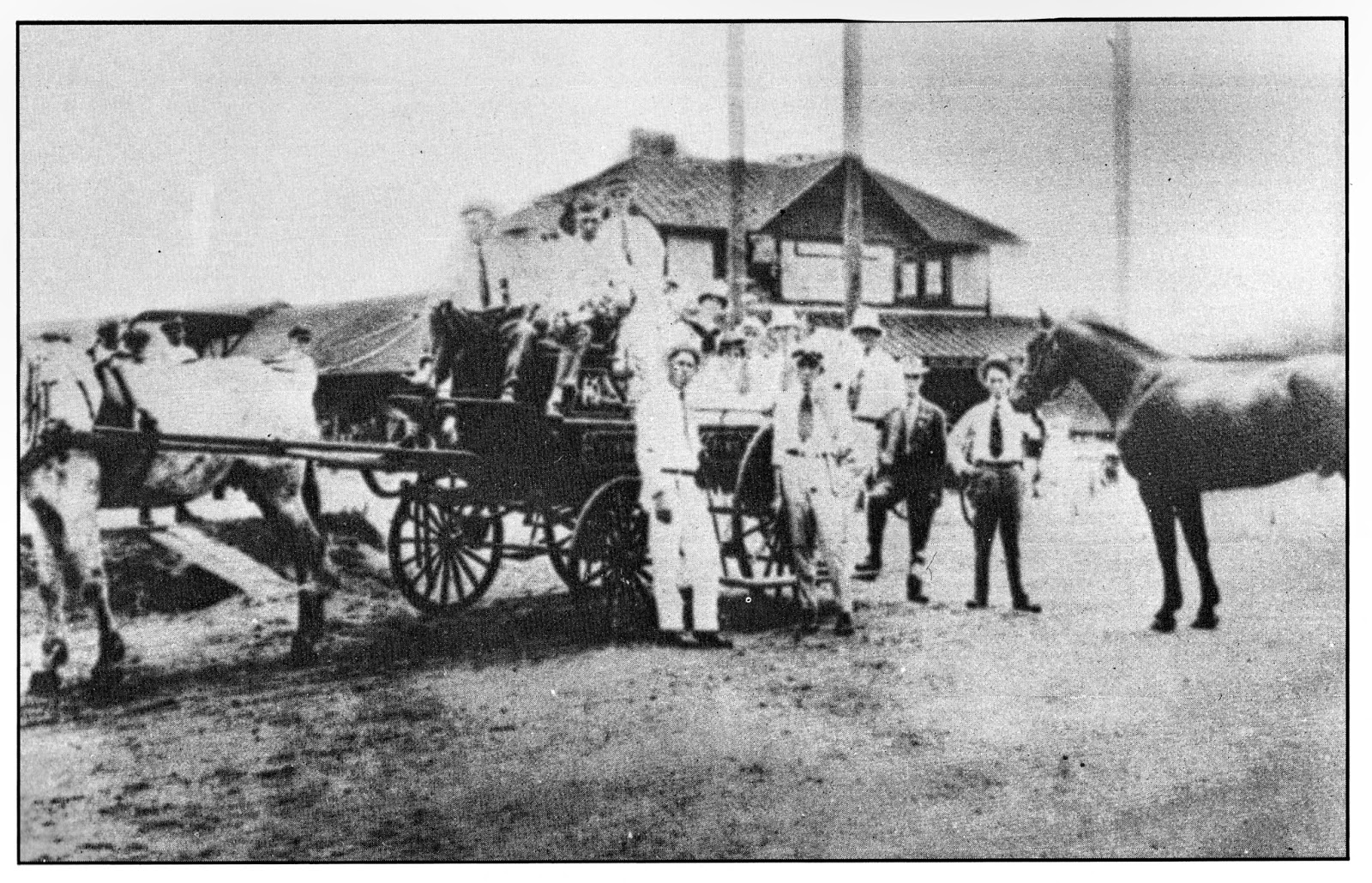
The first mention of an organized fire service in Kingstree came in February1873, shortly after a fire destroyed much of the block of Main Street across from the Williamsburg County Courthouse. At that time, the state of South Carolina granted a charter to the Pioneer Hook & Ladder Company of Kingstree. However, it appears that the company didn't last.

This presumably is "Our Pet," Kingstree's first horse-drawn fire wagon.
The Kingstree "fire laddies" won the horse at right in a contest in Orangeburg in 1910.
Source: Williamsburg County: A Pictorial History

In 1898, The County Record printed an editorial bemoaning the lack of a fire department in Kingstree. It noted that insurance rates were extremely high, so much so that it would soon be difficult to insure anything in the city limits of Kingstree. The paper argued that the amount citizens saved on insurance premiums would soon pay for the amount needed to set up a fire department.

No further mention of a fire department organizing is seen until 1901. On Friday evening, April 5, a large group of local men met at Brockington Drug Store on the corner of Main and Academy streets to form a local hook & ladder company, to be known as Kingstree Hook & Ladder #1. The men appointed W.R. Funk fire chief, with C.D. Jacobs as assistant chief. E.L. Smith was the company foreman, and attorney C.E. St. Amand was the secretary/treasurer. Dr. W.V. "Jack" Brockington would serve as surgeon.

A little over a year later, on July 10, 1902, lightning struck the stables and buggy house of Thomas & Bradham, located behind Barr's Hotel on Main Street, near the Courthouse Square. The fire was so large that it could be seen 10 miles from Kingstree, and only the direction of the wind saved the hotel for burning, as well. This fire was the catalyst for town council's adopting an ordinance regulating the construction of buildings and chimneys, particularly in the downtown area.

Two years later, on February 15, 1904, the Mt. Zion Methodist Episcopal Church, located on Main Street near the river was the victim of apparent arson. There had been a disagreement within the church, and it was felt that the arson stemmed from this. Kingstree's African-American chapter of the Odd Fellows had their hall next door to the church, and the fraternal organization agreed to allow the church to use its building after the fire. Then, on May 6, that building, as well as the school next door to it attended by the town's Black children also fell victim to arson. The Governor of South Carolina offered a reward for any information regarding the arsonists. These fires prompted the town council to build brick and cement reservoirs at the public artesian wells to help provide more water for fire suppression.

A few months later, on July 5, the stables at the rear of the Coleman House Hotel on Main Street caught fire, endangering the hotel. The bucket brigade sacrificed the stables to save the hotel and surrounding buildings. The County Record used this fire to push the town to buy a horse-drawn fire engine and to form a fire company, citing that now that the town had reservoirs, the next step should be the purchase of a fire engine. Town Council responded in early September by buying a fire engine which arrived at the end of the month. In October, council bought 500 feet of hose to equip it.

On October 18, 1904, Town Councilman H.A. Meyer held a meeting in the law offices of Stoll & Stoll to organize a fire company. Fifteen men enrolled in the Wee Nee Fire Company. Meyer was the President; Saul Marcus, Vice President; and Philip Stoll, Secretary. They were to have once a week hose drills, and Stoll was instructed to solicit more members for the company.

Six months later, in April 1905, W.W. Battiste's home on Hampton Avenue caught fire, pointing out the inefficiencies of the town's fire-fighting system. The new fire engine, which the firefighters had named "Our Pet," and the hose were hauled to the scene but a lack of water in that part of town made them ineffective. The bucket brigade was unable to save the Battiste house, but they were able to save the Episcopal Church next door, which caught fire in half a dozen places.


Hampton Avenue, with the Episcopal Church at left. The Battiste house
may be the yellow house beside the church in this photo.

The year 1906 ended with a massive fire on Main Street on December 31. All the buildings from the Courthouse west to Jail (now Jackson) Street burned. This included what was once Barr's Hotel, but was by then known as the Central Hotel and three other storefronts, including Dr. Wallace's drugstore. The County Record noted, "As usual, the engine "Our Pet" came prancing to the scene after the fire had burned itself out."

Several months later, on Monday, March 18, 1907, fire broke out in Meyer's Bakery at the rear of Scott & Miller's Market on the north side of East Main Street. The fire department was able to confine the fire to three wooden buildings between P.S. Courtney's store and the store owned by G. Ollie Epps on the corner of Main Street and Hampton Avenue. Three days later, the fire department re-organized yet again. This time, M.H. Jacobs was named chief, with W.E. James foreman of the nozzle; Tom McCutchen, foreman of the hook & ladder; and F.W. Fairey, pumping foreman. The Town of Kingstree agreed to refund the "foot tax" of every member of the fire department and to pay then $1 for every fire they worked.


M.H. "Uncle Monty" Jacobs
Source: Williamsburgh Historical Museum

In the summer of 1907, a gentleman named P.G. Howe was in town demonstrating his Howe Fire Engine which worked either by hand or with a gasoline motor attached. The town was interested in the machine, but apparently did not buy one.

On Sunday afternoon, May 18, 1908, a fire was discovered in Lesesne & Thompson's shop, located at the rear of Meyer's Bakery, which had relocated to the corner of Main & Academy streets after the March 1907 fire. The wooden building housing the bakery and Lesene & Thompson was destroyed, as was the general merchandise store of T.J. Pendergrass, one of the town's leading Black merchants.

A year later, on May 4, 1909, fire destroyed O.H. Patrick's home on Academy Street, prompting The County Record to note, "Anyone who was at the fire could readily see how badly Kingstree needs an up-to-date fire department with an available amount of water... and it is to be hoped that the city fathers will look into the matter in the near future."

In November of that year, the town was experimenting with a chemical fire extinguishing apparatus. It would not take the place of "Our Pet," the department said, but it could help contain fires until "Our Pet" arrived at the scene. The chemical engine got its first test when Young's Ice Cream Palace on Main Street caught fire. The machine worked very well, quickly extinguishing the fire, and in January 1910, Town Council bought two of the chemical engines for $500.

Saturday, December 17, 1910, started out as a busy Christmas shopping day in downtown Kingstree. Around mid-day, L.D. Rodgers was showing fireworks to a customer when one exploded, setting fire to the store and sending thick smoke belching from the building. The two chemical engines were employed and kept the fire from spreading until "Our Pet" arrived. Although not officially part of the fire department, a number of the town's Black residents worked tirelessly, pumping water from the reservoir into the hose to keep a constant stream of water directed at the fire. Several hundred spectators gathered, wondering if the newly-completed buildings that had replaced those lost in the fire of 1907 would also be reduced to ashes. The fire, however, was contained in the Rodgers store, and The County Record later noted that the reservoir at the well in the middle of the intersection of Main and Academy streets was instrumental in getting the fire out.


The James Brockington House at the head of Academy Street.

Almost a year later, shortly after midnight on Sunday, November 5, 1911, a Kingstree landmark was destroyed by fire. The old Brockinton home at the head of Academy Street was lost in a large blaze. The house was then owned by the Rev. W.S. Martin and rented by W.E. Jenkinson. Mr. Jenkinson was able to save the piano, but all other furnishings were lost, and he suffered a severely mashed foots for his efforts. The fire was so hot, that a number of trees in the yard were severely scorched, and it was thought that they, too, would not survive.

The next week, the Kingstree Fire Department again re-organized. This time it made notable structural changes. Although Black residents had joined bucket brigades and most recently operated the pump at fires, they had never been allowed to be a formal part of the fire department. The department now organized a Black fire company to be in charge of getting "Our Pet" to fires and making sure there was water to operate it.

During the early years of the community, the sextons of the three churches on Academy Street tolled the church bells as a fire alarm. Apparently, by the early 1900s, the means of sounding the alarm had become the shooting of pistols. However, as it was not uncommon to hear gunfire on the streets of Kingstree in the early days of the 20th Century, The County Record noted, "It leads one to wonder how residents distinguish gun shots used as a fire alarm from "sounds of disorder."


The Nettles Hotel, scene of a 1913 fire, is now known as the Marcus Building.

On January 31, 1913, the night policeman discovered a fire in the old Nettles Hotel above Jenkinson Brothers and Milhous & Jennings on Main Street. The Hotel, while still leased by S.A. Nettles, was no longer functioning as a hotel but was used for overflow from the Kellahan Hotel and was also used for storage. Several rooms had recently been rented by a family as housing. This would be the first test of the performance of the town's new municipal water system during a fire. Fifty thousand gallons of water were dumped on the fire, confining it to the old hotel, leaving the ground floor unharmed by the fire, although there was considerable water damage to the merchandise in both first-floor stores.


Firefighter Greg Ward dusts one of the fire trucks.


The Kingstree Fire Department will soon occupy its new building on Longstreet St.

Through the years, the Kingstree Fire Department has continued to make improvements and to grow. Today as the department prepares to move into brand new quarters, Chief Tim Duke has eight paid staff members and 29 volunteer firefighters. The Town of Kingstree has a Class 3 Insurance Services Office (ISO) rating, the impact of which is still seen in lower fire insurance premiums. The department answers between 400 and 600 calls a year, according to Assistant Fire Chief Jeremy Morris.

Wednesday, June 17, 2020

Pulitzer Family Had Ties to Kingstree, Williamsburg County

The last post noted that during the 1920s and '30s, Kingstree and Williamsburg County became something of a winter colony for rich Northern businessmen. One of those men was Ralph Pulitzer, whose father Joseph's will endowed what we know today as the Pulitzer Prizes, awarded each year in newspaper, magazine and online journalism, as well as in literature, history, and musical composition. In the March 9, 1931, issue of The News & Courier, Laura C. Hemingway wrote about Ralph Pulitzer and his Williamsburg County home, Burrows Hall. Here is her story:


BurrowsHall as it looked in 1931.

When Ralph Pulitzer, publisher of the recently discontinued New York World, leased Burrows Hall, some 15 miles south of Kingstree in Williamsburg County, for a hunting lodge, bringing there on various occasions parties of friends from the metropolis to enjoy the hospitality of the old house and to get into the field with him in search of the quail native to the place, he hardly knew that he was bringing into effect an old idiom that "history repeats itself."

Burrows Hall, besides being one of the earliest of Williamsburg County homes, is one of the most interesting for many reasons. To it clings a glamor of pristine southern hospitality intermingled with that of the north when an interchange of visits between the two sections was not an accepted fact as such are in this day of fast passenger trains and paved highways reaching from the far corners of northern states to those of Florida. To it William Burrows, who occupied the house in 1800, was accustomed to bringing his friends from New York to partake of the social life of that section, one of the most historic and one of the most cultured in Williamsburg County. An abundance of everything good to eat and drink was to be had.

The little wine house still stands close to the wide veranda that runs around three sides of the house, reminding those of the 20th century that in those days a cellar was worthy of the name. It is said that Mr. Burrows kept on his sideboard decanters of the choicest wines and bowls filled with various kinds of fruit out of season. He was a genial host who spared no pains to make his guests comfortable and at ease. None who came to his home lacked for ready service and attention.

Great logs were piled high in the massive fireplaces around which the southern host and his guests gathered to enjoy an evening of camaraderie. The visitors from the north were no less amused and entertained by the southern dialect than were local guests by that of the Yankees. Dr. (Samuel) McGill, in his Reminiscences of Williamsburg County,  paints a fetching picture of a scene like this. He speaks particularly of one local guest by the name of Jack Singletary, who evidently was the "jester" of the group. "Jack," says the doctor, "was as much of a curiosity to them (speaking of the northern visitors) as their Yankee slang was thrown back at them with a hearty laugh all round."

Just who built Burrows Hall is not known with any degree of certainty. Not until William Burrows became its master did it come into any noticeable prominence. Perhaps this was due to the personality of the man. Dr. McGill describes him as being "wealthy, intelligent, and liberal." He inherited Burrows Hall from his uncle, George Burrows. After coming into this property, he was recorded as being the second best taxpayer in the county. While still a young man he frequently visited New York, living there for a time, where he made numerous friends. It was these he invited to his home upon his return here. His table was laden with "New York" dishes, as the people of the community described them, and his double-cut flint decanters and tumblers were the talk of the community for many a day.

Burrows Hall was the only plantation in Williamsburg County to boast an ice house. William Burrows had a far-seeing eye where the comfort of his family and guests were concerned. He had built near the home an ice house, having double brick walls, with a space between the walls filled with sawdust to preserve a low temperature during the hot spring days. "The sight of ice on a hot day was a new source of pleasure to us," writes Dr. McGill. Natural ice from the frozen lakes of the north was shipped in four or five ton lots on schooners to Georgetown. There is was loaded on flats and brought up Black River and Black Mingo Creek to the landing at old Willtown, now a deserted village, then a flourishing trade center. Wagons from Burrows Hall were waiting there to haul the ice to the plantation where it was stored in the ice house. Visitors to Burrows Hall today can see the brick ice house standing near the Hall.


Ralph Pulitzer

Burrows Hall was built in a day when houses were not thrown together for temporary residence, but were constructed in a way to defy time and change. It was built of heavy heart timbers that had been hewn out by hand. These are today solid. Wooden pegs were employed to hold together the body of the building. The nails, hinges, latches, bolts and the like were all hand-forged on the plantation. The original building has had several additions, the most recent having been made by Mr. Pulitzer, when he had a wing, two-stories high, built onto the rear.

The colonial architecture has been preserved. The cornice around the high ceilings of the main rooms and that underneath the eaves on the exterior are hand-carved. The mantels in the two large rooms on the front on each side of the hall are hand-carved and beautiful. These have been defaced by former tenants who were careless with the fires placed in the large chimneys.

Originally the grounds were landscaped according to plans of that day. An avenue of fine trees led down to the public road. In latter years tenants took it upon themselves to cut down many of these, but one of the first things Mr. Pulitzer did upon leasing the place was to have a landscape artist come down from New York and restore the grounds to their original attractive state. Evergreen trees of massive proportions were set out along each side of the avenue and masses of shrubbery placed at intervals along the driveway. A number of magnolia and japonica trees, nobody knows how old, were removed from ancient gardens in the neighborhood of Charleston and brought here on large trucks with trailers, where they were set successfully in the Burrows Hall gardens. The house stands on a little rise of land well back from the public road. The acres sloping off on every side have been planted to winter rye, and this is pleasing.

As the former master of Burrows Hall liked to have his guests enjoy themselves, so does the present master. Tennis courts have been built and a swimming pool of gigantic proportions, made of cement and filled with water from an artesian well on the plantation. The pool measures 25-feet by 50-feet. It has a floor sloping from five-to-nine feet. This is enjoyed by members of local 4-H clubs and young people from Kingstree during the time Burrows Hall is vacant.


In the rear, the pedigreed dogs used by Mr. Pulitzer and his guests in the field are housed better than many persons. These are in the care of a young man who loves dogs and knows how they should be treated.

Although quail are plentiful in the fields surrounding Burrows Hall that Mr. Pulitzer has leased for his preserve, he had last winter shipped in at one time from another state 2,500 birds to be released on his preserve. His guests always return to the lodge with their bag limits.

Mr. Pulitzer has recently purchased more than 4,000 acres of land in the proximity of his lodge. Of this perhaps a hundred acres have been planted to grain to be used as bird feed. On the courthouse books are recorded 688 acres of the Jesse Fulmore tract, 2,631 acres of the undivided McCutchen estate, and 960 acres of the Kennedy estate, purchased by the master of Burrows Hall.

Burrows Hall is situated in the Indiantown section of Williamsburg County, named for the ancient Indian village of which traces remain today. Almost within a stone's throw of the lodge the black waters of McCottry's Lake reflect the boats bearing local anglers here and there on its glassy surface, \ water once bright with reflections of the Red Man's colorful dress. In the churchyard of the Indiantown Church, a place historic within itself, lies the child of a sister of Woodrow Wilson and also many persons who have left their names on the historical scroll of the state (including the aforementioned Dr. S.D. McGill).

It is with pleasure that those who love history for history's sake see old homes of colonial charm restored to their original state of attractiveness. When Mr. Pulitzer brings down from New York his distinguished visitors, those who are familiar with facts of the past like to feel that it is only history repeating itself. Hospitality once again reigns at Burrows Hall. Among visitors there are those whose names are written on the pages of fame, Mrs. Pulitzer herself being known as a novelist of acclaim. Neysa McMein and Rockwell Kent have been among the artists entertained there of late.


Rockwell Kent

I would add to Laura Hemingway's story by noting that artist Rockwell Kent on a visit to Burrows Hall in 1929 produced a bookplate, entitled Kingstree, SC. I have never seen a copy of the print although I believe that it is still in existence. A pencil draft of the bookplate is in Columbia University's Rockwell Kent collection. The Rhode Island School of Design Museum has no online image but lists the bookplate with the notation, Westchester County Recreational Commission.

Ralph Pulitzer's brother Herbert was also involved with Burrows Hall. Mr. and Mrs. Frank Taylor had acquired the property from William Burrows and owned it for about 50 years. The Pulitzers leased the house from the Taylors' son, Dr. William Taylor, who was a prominent Presbyterian minister in Washington, DC, having served as President Woodrow Wilson's pastor.

Thanks to the Pulitzers, Kingstree was on the front page of the New York Times in the spring of 1928 when Ralph Pulitzer, Jr, and his cousin, W. Seward Webb, III, drove from Kingstree to Manhasset, Long Island,  New York, in one day, a distance of 752 miles. They left Burrows Hall in separate cars at 2:10 one Saturday morning, arriving on Long Island shortly before midnight. Webb drove the entire distance himself, although he was accompanied by his family chauffeur. Pulitzer drove all but the last 50 miles, which were driven by his brother, Seward Pulitzer.

In March 1930, an epidemic of distemper swept through the dogs in Kingstree and Williamsburg County. One of Ralph Pulitzer's pure bred hunting dogs died of the disease. Veterinarian Dr. H.B. Hood ordered vaccine from Atlanta in an attempt to save the lives of Pulitzer's nine remaining dogs.

The Pulitzers owned the property from 1928-1940. It remained empty until Elwood Blanton and his family moved there in 1953. The Blantons had just begun renovating the house when it burned on Mothers' Day 1958.

Wednesday, June 3, 2020

Bonus Army Cleared Ground for Golf Course

Today, the Swamp Fox Golf Club lies just west of Kingstree off the Manning Highway. Two separate historical movements played a major role in its development.


In the 1920s and '30s, Kingstree and Williamsburg County had become a "winter colony" for a number of rich, northern industrialists and businessmen. Some owned plantations they turned into game preserves for hunting. A few owned houses in Kingstree. Some only spent winters here; others, like Howard Hadden, owner of Springbank, were here for as many as eight months out of the year.

In the early 1930s, businessmen in Kingstree began talking about the possibility of building a nine-hole golf course as another attraction for northern sportsmen. The Kiwanis Club took the golf course on as a project and was able to secure 115 acres four miles from Kingstree off the Manning Highway from Miss Susan Gourdin in early 1935. A Board of Directors was established for the golf course. The board included Howard S. Hadden, T.M. Gilland, F.W. Thomas, J.D. O'Bryan, the Rev. E.W. Cantwell, Thomas McCutchen, and A.M. Schrieberg. 

The board hired Robert White as architect for the course. In 1916, White was named the first President of the Professional Golfers Association of America (PGA). After his tenure with the PGA, he designed a number of golf courses throughout the eastern United States.


Robert "Bob" White
Source: Wikipedia

The drive to establish a golf course near Kingstree intersected with another movement that brought the labor for clearing the land for the course to town. Military personnel serving in the World War had been promised a bonus for signing up. They were to receive $1 a day for every day they served while in the United States, and $1.25 per day for days served overseas. However, once the war was over, the federal government was reluctant to pay the bonus. Twice Congress passed bills to pay the veterans, but both President Warren Harding and President Calvin Coolidge vetoed them. Congress was able to override the Coolidge veto, but by the time settlements could be agreed upon, the stock market had crashed in October 1929, and President Herbert Hoover announced that the bonus payments would be postponed until 1945 or until the veteran died. Many veterans then began calling the bonus the Tombstone Bonus.

Many of the veterans who returned were suffering from what we would call today PTSD. Some had been gassed; others were shell-shocked, and many had become alcoholics in trying to deal with the stresses of attempting to return to civilian life. Frustrated by what they perceived as foot-dragging by the federal government, they formed themselves into what they called the "Bonus Army," and during the Hoover administration, they staged a march on Washington, D.C., which was dispersed by federal troops. After Franklin Delano Roosevelt was elected President, his administration feared a repeat of the protests and came up with the Federal Emergency Relief Administration (FERA), which was to set up camps for the veterans who were having trouble re-entering society. They would be given work and paid $30 a month. One of the first camps set up in November 1934 was called Camp Williamsburg.

It was located about four miles south of Kingstree at Red Hill on Black River at the site of an old Civilian Conservation Corps Camp. P.G. Gourdin was hired as supervisor for the camp. Initially 236 men were brought to the camp. Some of them were sent to Georgetown daily where they worked at planting pine trees; others were given the job of cutting fire lanes in existing forests and rebuilding and improving fire towers. Still others were responsible for clearing the land that was to become the golf course.

By early 1935, there were 170 men in camp from 38 states, representing 62 different occupations. They were admittedly sometimes a rough lot.

The Charleston Evening Post of May 30, 1935, reported that one of the campers was in Kelley Sanatorium in Kingstree, missing one-half inch of the end of his nose after an altercation in which another camper had bitten it off. "Stranger still," the paper said, "his nose was pinned to the bulletin board at Camp Williamsburg." The paper went on to describe that after the camper had been taken to the hospital, Dr. E.T. Kelley received a phone call from the camp, reporting that the missing part of the nose had been found and asking if he wanted it brought to town. Dr. Kelley's reply was reported as "Too late now. We've done the best we could with what was left."

Despite the work, many of the men still had problems adjusting to civilian life and in August 1935, about 20 of them got drunk one Saturday night. Taken to the county jail, they wrecked the second floor, breaking out windows and screens and defacing the walls. One newspaper article pointed out that despite their numbers and their drunkenness, the sole Kingstree police officer on duty was able to quiet them down. The article noted, "They will whoop and curse and stagger about, but they are so depressed that they obey the first command of authority, regardless of their alcoholic condition." And they willingly paid for the damage they had inflicted on the jail.

However, The New York Times sent a reporter to Kingstree and a lengthy story appeared later that month. It painted a picture of a town that was "continually disturbed" by the campers. One Kingstree woman reportedly said, "When these men are around on and after their pay day, a lot of women here drive to Florence to shop. They just cannot risk going into the stores here." Another woman reportedly returned home to her home on Main Street one afternoon to find that one of the veterans had wandered into her house and was "sleeping it off" in the master bedroom. Town children, the article stated, were no longer allowed to play outside as their mothers didn't want them exposed to the language often used by the men of Camp Williamsburg.

The article also took great pains to point out that no one in Kingstree played golf, making it appear as if the campers were randomly building a golf course that no one would use. No mention was made of the reasons why the Kiwanis club had started the golf course project. The article quoted "one disgruntled veteran," who said, "Hell, I'll bet there ain't a whole bag of them golf clubs in forty miles of this tank town."

The campers were incensed by the Times article, and they wrote a letter to the editor, refuting each statement made in the story. The letter noted that women and children from Kingstree often came to the camp to eat with the campers and to provide entertainment by singing for them. Businessmen from the area were making monetary contributions toward the upkeep of the camp, the letter said.

However, the government announced that three of the FERA camps in South Carolina would close in September 1935, with veterans who were still homeless and unable to fend for themselves entering the Civilian Conservation Corps. The Kingstree Camp remained open to house those veterans who, for whatever reason, could not or would not enter the CCC. These remaining vets would be paid $1 to $3 a week instead of the $30 a month.


Looking across one of the original nine holes at the Swamp Fox Golf Club today.

To make a long and convoluted story shorter, the golf course was completed, and in November 1935, the course's board of directors hired Jack Hitchcock to serve as the course professional. A native of Toronto, Canada, he had been the course pro at Charlottetown Course on Prince Edward Island before coming to Kingstree. When he moved here, he initially stayed with Howard and Agnes Hadden at Springbank. As for the Bonus Army, the United States finally paid the World War veterans their bonus in 1936. The Bonus Army is a little remembered story from U.S. history. If anyone is interested in learning more about the Bonus Army, you might want to read The Bonus Army: An American Epic by Paul Dickson and Thomas B. Allen. Several paragraphs in the book are devoted to Camp Williamsburg and Kingstree.

UPDATE:  The November 7, 2018, post about jazz bandleader Amos White recently elicited a comment from Steven Fiche, who is helping Amos White's grandson,  Dr. Eddie "Snakepit" Edwards build a website on which to archive his music, videos, and art. In the Gallery on the website, you will find a picture of a much older Amos White with his grandson, Eddie, who is a saxophonist.